

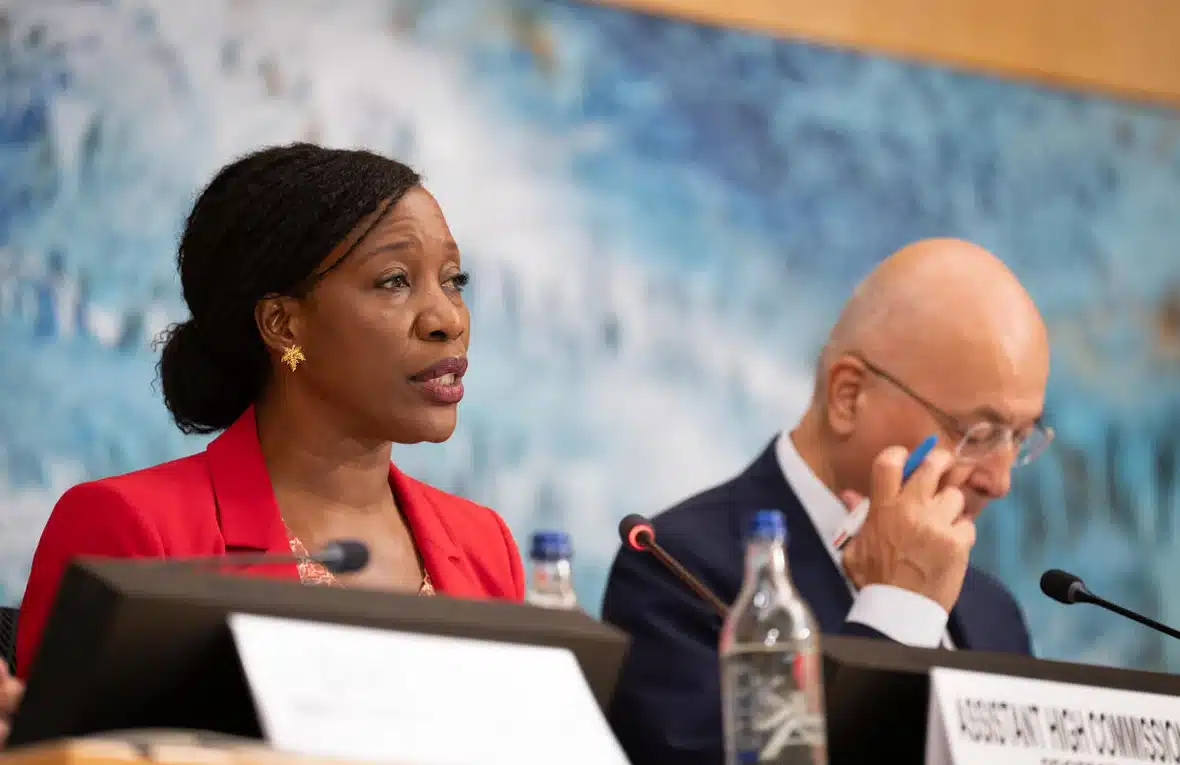
UNHCR Assistant High Commissioner for Protection, Edem Wosornu, delivers a speech on international protection alongside UN High Commissioner for Refugees Barham Salih at the 77th Executive Committee meeting in Geneva. © UNHCR/Anne-Laure Lechat
Chairperson,
Distinguished delegates,
High Commissioner,
Ladies and gentlemen,
It is an honor to address the Executive Committee as Assistant High Commissioner for Protection and to introduce the international protection agenda item, including the Note on International Protection presented by my predecessor, Ruven Menikdiwela, at the June Standing Committee.
In my first weeks in this role – six weeks to be exact – I have appreciated the support and cooperation extended by so many delegates and partners, and I look forward to strengthening this collaboration and engaging closely with you in the period ahead.
In these early conversations with you, we have heard concerns about a world under strain: conflicts multiplying, displacement reaching record levels, resources shrinking, political divisions deepening.
But we have also heard something else. We have heard a continued belief that international protection matters, and that UNHCR’s protection and solutions mandate is needed more than ever.
That conviction has echoed throughout this anniversary year of the 1951 Convention relating to the Status of Refugees and the 1961 Convention on the Reduction of Statelessness. Across regions, States have reaffirmed a simple but powerful truth: the principles that protect refugees and stateless people are not relics of the past. They are essential tools for navigating the challenges of today.
Last month, during the United Nations General Assembly High-Level Week, States, regional organizations, faith leaders and a wide range of partners reaffirmed their support for the Refugee Convention. Their message was clear: while the world has changed dramatically since 1951, the Convention has not only stood the test of time, it has guided the international community throughout. Many of you have reiterated this message over the past few days during this Executive Committee Meeting.
The world of 2026 is very different from that of 1951. The scale of displacement has reached levels that the drafters of the Convention could not have imagined. By the end of 2025, around 117.8 million people were forced to flee their homes, including 41.6 million refugees and 68.7 million internally displaced people.
Displacement is also becoming longer. As our High Commissioner has put it, “for too many refugees, displacement starts as a lifeline but lasts a lifetime,” with seven out of ten refugees living in protracted displacement.
At the same time, conflicts, instability and climate-related shocks are increasingly intersecting and compounding displacement. Three quarters of the world’s forcibly displaced people live in countries highly exposed to climate hazards.
Excellencies,
These challenges do not diminish the relevance of the Refugee Convention. They make its effective implementation more urgent. Now is the time to strengthen practice, not weaken principles.
The question before us is not whether the Convention is still relevant. The question is whether we have the collective determination and the political will to make it work for the realities of our time.
That determination must be reflected in three areas that are vital to future-proofing international protection, and which will form the foundation of my intervention today.
- First, we must safeguard asylum and uphold the right to nationality.
- Second, we must build and finance national protection capacity.
- And third, we must turn protection into inclusion and solutions through responsibility-sharing.
1. Safeguarding asylum and upholding the right to nationality
At a time when asylum is increasingly contested, when externalization arrangements and restrictions on access to territory risk becoming normalized, and when responsibility-sharing remains profoundly uneven, we need to do better. The answer is not weaker international protection. The answer is more effective implementation.
Seventy-five years after the adoption of the Refugee Convention, its core principles – access to territory, fair procedures, due process, non-refoulement and compliance with international law – remain as relevant as ever.
UNHCR’s normative and policy work remains central to advancing these principles. Pursuant to its supervisory responsibility, UNHCR continues to provide legal and policy guidance that supports the consistent application of international refugee law. This includes its unique role as amicus curiae. Last year alone, UNHCR provided expert submissions in some 18 cases across 13 jurisdictions to assist national courts in addressing complex questions of international refugee law. Beyond the individual cases, court decisions in these matters are often precedent-setting, with global resonance.
Last week, at the Annual Conference of the European Chapter of the International Association of Refugee and Migration Judges (IARMJ) in Paris, I heard judges, including from the European Court of Human Rights and the European Court of Justice, expressing support and appreciation for UNHCR’s legal and policy guidance.
To strengthen this critical work, UNHCR is developing the Handbook on Refugee Law, which consolidates the 1979 Handbook and UNHCR’s Guidelines on International Protection into a single authoritative resource. The Handbook is firmly anchored in the fundamental principles of refugee protection. Through updated guidance, the Handbook will provide clear recommendations to address contemporary challenges and on criteria and procedures for the determination of refugee status. For the first time, it will also provide an exhaustive appraisal on the substantive content of the rights of refugees. We are grateful to the Government of the Netherlands for its support to this initiative.
UNHCR also continues to support States in addressing some of the most difficult questions facing asylum systems today, including mixed and onward movements, lawful transfer arrangements, return procedures, and the situation of refugees who commit serious crimes in their host States. Our objective remains clear: helping States respond to and navigate complex realities while preserving the integrity of international protection.
Mixed movements have become one of the defining policy challenges of our time.
People travelling along the same routes often have different circumstances, vulnerabilities, aspirations and, of course, protection needs. Refugees are forced to flee; migrants may move for economic and other reasons. At the same time, refugees themselves may continue to move when protection remains unavailable, when rights cannot be realized, when assistance is insufficient, or when opportunities to rebuild their lives are absent.
This is one reason why the route-based approach, jointly developed and advanced by UNHCR and our partner IOM, has proven particularly valuable. Its premise is straightforward: act early, cooperate along routes, address risks before they become crises, and invest in protection and opportunities before people are forced to undertake dangerous onward journeys.
UNHCR, together with IOM and other partners, provides protection and referrals to national services to reduce risks and avoid exploitation.
Organizations led by refugees and stateless people are key players in route-based responses, including in contexts where other actors are not present or may have limited trust with refugees and others on the move. In eastern Chad, the refugee-led organization RE-HOPE mobilized 6,500 volunteers to raise awareness of trafficking and exploitation risks and strengthen community protection efforts. In Malaysia, refugee- and women-led Teen Health International is supporting newly arrived and at-risk refugees with psychosocial support.
Mr Chair,
Central to UNHCR’s work is the right to nationality for all.
Nationality is much more than a legal status. It is a lease on life. It is access to education. It is access to health care. It is access to work. It is recognition. And ultimately, it is belonging.
Since 2014, more than 650,000 people have acquired or had a nationality confirmed. Thailand’s efforts to resolve statelessness affecting more than 450,000 people demonstrate how political will, inclusive legislation and practical administrative action can transform lives at scale.
We have also seen progress elsewhere. North Macedonia has resolved all known cases of statelessness linked to the dissolution of the former Yugoslavia. Burkina Faso and Mali have adopted important reforms to strengthen the rights of stateless persons and facilitate access to nationality. Canada and Viet Nam have restored nationality rights to citizens overseas.
On Tuesday, during our side event on Statelessness, we heard compelling examples from Rwanda, from Côte d’Ivoire, from the Philippines, from the Council of Europe and from the stateless-led organisation, Statefree, on progress and ongoing efforts to end childhood Statelessness – all of these driven by political will.
These examples remind us that statelessness is not inevitable; it is solvable.
Looking ahead, we see both emerging challenges and opportunities on the horizon.
For example, climate change is introducing new risks and vulnerabilities. Our task is to anticipate those risks and respond collectively. In that spirit, UNHCR issued the Global Recommendations on Nationality and Statelessness – the first ever global guidance on preventing and reducing statelessness in this context.
Digital identity systems hold considerable promise for the identification, prevention and resolution of statelessness. However, they can also exacerbate exclusion if not designed carefully. A new World Bank guidance on Building Statelessness-Sensitive ID Systems is an important practical tool to inform these efforts.
Excellencies,
Let us build on the momentum we have generated over the past decade. We invite States that are not yet parties to the 1954 and 1961 Conventions to accede to them. Let me also take this opportunity to call on all States and other partners to join the Global Alliance to End Statelessness, so that everyone, everywhere, can enjoy the right to a nationality.
2. Building and financing national protection capacity
Distinguished delegates,
If strengthening implementation is our objective, then capacity and resources are indispensable to achieve it.
Institutions do not function on principles alone. They require investment. And investment in protection is becoming harder to secure, at a time when it is needed the most.
Today, displacement is increasing while resources are moving in the opposite direction. Official development assistance recorded its largest drop on record. We’ve heard from the High Commissioner, we’ve heard across the board, that humanitarian funding has also declined sharply. Resource gaps are not merely financial realities. They are reflections of political choices.
The consequences are increasingly visible. Across many regions, asylum systems face growing backlogs due to underinvestment, lengthy procedures, and overstretched institutions. At the end of 2025, approximately 9 million people worldwide were awaiting decisions on their asylum claims.
This is not merely an administrative challenge. Fair and efficient asylum systems serve a dual purpose. They ensure that refugees are identified and protected, while also providing clarity regarding those who are not in need of international protection, and whose situations can be addressed through national immigration procedures, including return, in dignity, where appropriate. When systems are under-resourced, both objectives suffer.
Funding shortfalls have also affected humanitarian actors. Difficult choices are increasingly becoming the norm, forcing organizations to determine whose needs can be met and whose must wait. Where we can operate, and where we cannot. And for UNHCR, as you have heard, we have received 35 per cent of our total requirements for 2026.
UNHCR has continued to prioritize protection. Our forthcoming Strategic Directions reinforce this commitment. But funding cuts of this scale inevitably have an impact.
The impact is being felt: By the family unable to obtain legal status. By the separated child awaiting reunification with their parents. By the woman seeking specialized services after surviving sexual violence. By the returnee struggling to recover property and housing. And by the stateless young person seeking recognition of their nationality that should have been theirs by right.
In the face of these constraints, UNHCR is adapting and transforming the way we deliver protection. Across multiple operations, we are investing in digital registration systems that accelerate registration, improve data quality, strengthen documentation and support the effective delivery of assistance. This transformation is underway in pilot countries including Egypt, India, Indonesia, Iraq and Pakistan, and we’ve got plans to expand also to Rwanda and Nigeria as resources allow. More funding is required to accelerate this transformation and extend its benefits to those who need it most.
Our objective remains strengthening national asylum systems so that States themselves can sustainably deliver protection. Yet underfunding is slowing progress, increasing backlogs and prolonging uncertainty for people seeking safety. In countries where national asylum systems do not exist or are unable to provide fair and efficient procedures, UNHCR continues to undertake refugee status determination. However, due to the combined effect of shrinking resources and operational constraints imposed by local authorities, the number of countries in which UNHCR conducts refugee status also declined over the past years, from 51 in 2024, to 42 in 2025, and 32 in 2026.
The consequences of underfunding, Excellencies, distinguished delegates, extend beyond asylum systems. In 2025, through States, donors, UNHCR and our protection partners, 1.5 million children and caregivers received protection services across 69 operations. But reduced funding left nearly half of the children and caregivers UNHCR had planned to assist without support.
Gender-based violence programmes have faced similar challenges. In 2025, UNHCR and partners reached 1.6 million people with gender-based violence programming across 77 operations, with local and refugee-led organizations playing a vital role. Budget cuts came at a steep cost, leading to the closure of 171 Safe Spaces, and 45 per cent of operations reporting locations where all GBV services had ceased.
3. Turning protection into inclusion and solutions through responsibility-sharing
Excellencies,
If protection gives people safety, solutions give them a future. The High Commissioner’s 50 by 35 initiative challenges us all to rethink how success is measured.
Success is not only counted by the assistance we provide. Success must also be measured by the opportunities refugees gain, the rights they enjoy and the futures they are able to rebuild.
At its core, 50 by 35 seeks to ensure that refugees can enjoy the rights envisaged by the Refugee Convention: to live in safety and dignity, move freely, access education and employment, and to contribute to society.
For many refugees, peace remains the surest pathway home. Nearly two-thirds of the world’s forcibly displaced people originate from just seven countries. The search for solutions must therefore include renewed diplomatic efforts to address the conflicts driving displacement.
For those unable to return, resettlement remains a vital lifeline. However, available resettlement places have fallen to only 24,000 globally for an estimated 2.4 million refugees in need – 1 in 100 places for every person in need. Canada has demonstrated remarkable leadership, accounting for nearly half of UNHCR resettlement referrals in 2026, followed by Australia – another important resettlement partner. I call on States to expand resettlement opportunities as a tangible way to demonstrate that responsibility for protection is shared; it is not the burden of frontline host countries.
Complementary pathways also have a critical role to play. Education pathways are helping young refugees move from dependency towards self-reliance and are a central component of the High Commissioner’s Aiming Higher initiative. Labour mobility programmes are similarly transforming lives. Recent initiatives connecting refugees in Kenya with employment opportunities abroad illustrate what becomes possible when skills, protection and opportunity are brought together. Similar programmes in Australia, Canada and Italy have demonstrated their potential.
Local integration remains another essential part of the solutions toolbox. In Mexico, some 50,000 refugees have acquired nationality. In Armenia, more than 34,000 refugees have done the same. Botswana has also shown leadership in this area. These examples demonstrate what is possible when States create pathways towards inclusion and belonging.
This is what the Global Compact on Refugees is about: a shared framework for responsibility-sharing and collective action. The Global Refugee Forum Progress Review showed pledges translating into laws, policies and programmes that expand access to work, education and nationality. It also showed where we need to do more to support host countries and expand solutions.
Solutions for internally displaced persons
The search for solutions is equally urgent for internally displaced people.
In Ukraine, UNHCR has supported the establishment of IDP Councils that strengthen participation and engagement with local authorities.
In Colombia, UNHCR supported the adoption of a National Durable Solutions Policy that brings together humanitarian, development and peacebuilding efforts under a common framework. And through the Global Protection Cluster and other coordination mechanisms, our organization continues to work with governments and partners to strengthen protection responses and advance solutions for displaced communities around the world.
Conclusion
Chairperson,
Distinguished delegates,
High Commissioner,
Ladies and gentlemen,
Seventy-five years ago, the international community emerged from the devastation of war and made a remarkable difference.
States chose cooperation over indifference. States chose responsibility over exclusion. States chose protection over abandonment. That choice gave us the 1951 Refugee Convention and the global protection framework.
Today, the world faces different challenges, but the same fundamental test. Will we retreat from these commitments? Or will we renew them through better implementation?
Throughout this anniversary year, we have repeatedly heard from governments, displaced and stateless people, mayors, parliamentarians, faith leaders, civil society organizations and international partners: the framework works, the principles are sound, the solutions known. Our task now is to catalyze the political will, partnerships and resources needed to bring them fully to life.
As we look forward to the High Commissioner’s Dialogue in December and to the Global Refugee Forum in 2027, let us move beyond reaffirming commitments and focus on implementing them. These are critical opportunities to demonstrate progress, mobilize new resources, and translate ambition into measurable results.
Let us safeguard asylum.
Let us invest in protection.
Let us realize nationality for all.
Let us advance peace.
Let us expand solutions.
And as the Secretary-General stressed in his remarks at the High-level Event at this year’s High-Level Event, let us “choose diplomacy over division. Solidarity over narrow self-interest. And humanity over indifference”.
Thank you.