

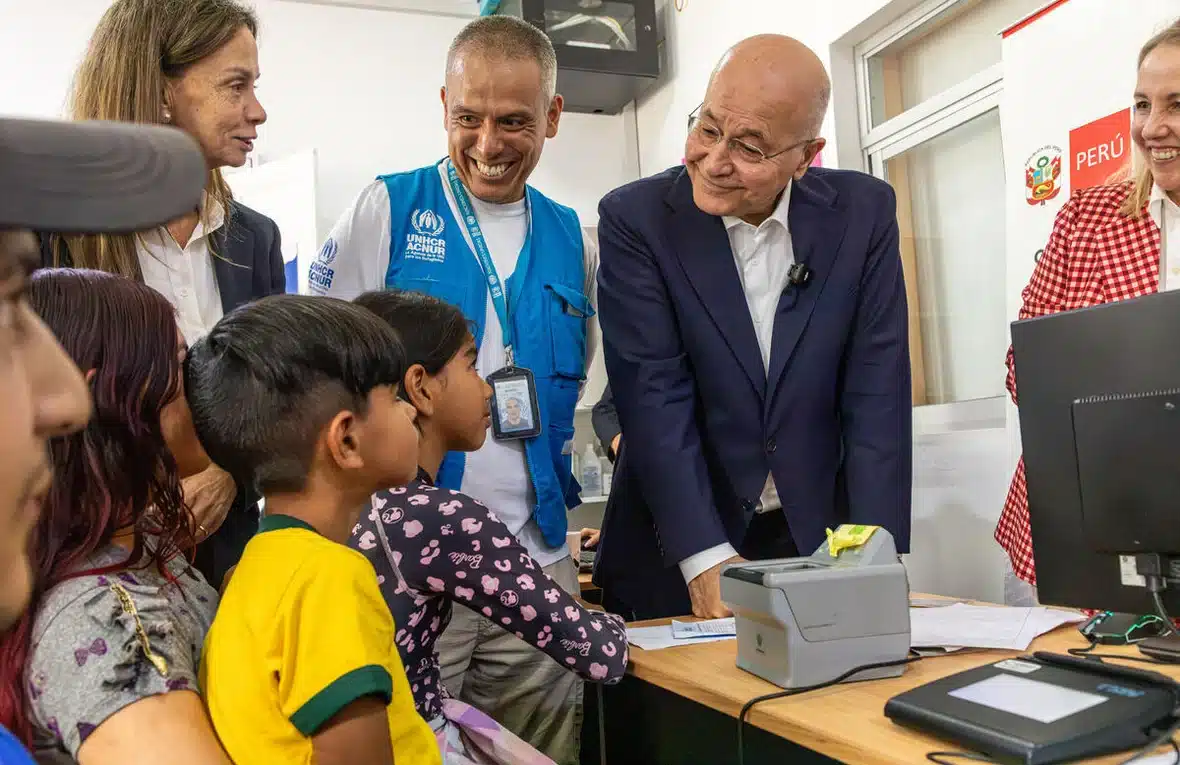
UN High Commissioner for Refugees Barham Salih and colleagues speak to a family from Venezuela at a protection centre in Lima, Peru. © UNHCR/Jaime Giménez
CARACAS – UN High Commissioner for Refugees Barham Salih has concluded a seven-day visit to Mexico, Peru and Venezuela by underscoring Latin America’s enduring leadership in protecting people forced to flee. Building on a long tradition of solidarity, the region has been demonstrating how protection can be translated into progress towards inclusion, stability and solutions, in line with UNHCR, the UN Refugee Agency’s, 50 by 35 vision to reduce dependence on humanitarian aid.
Advancing this progress will require sustained investment, practical action and strong partnerships to turn protection into opportunity – helping displaced people, returnees and their hosts access documentation, education and work, rebuild their lives and contribute to their communities.
“People who are forced from their homes do not leave their hopes, talents and ambitions behind,” said Salih. “With the right opportunities, they can learn, work, contribute and shape their own futures. Our responsibility is to help make those opportunities real.”
In Mexico, Salih met Minister of the Interior Rosa Icela Rodríguez and Foreign Minister Roberto Velasco, welcoming the Government’s commitment to refugee protection and advancing México Integra, a State-led strategy that builds on more than a decade of successful refugee integration. He addressed the Senate on refugee protection and inclusion and welcomed the signing of The Promise by the Head of Government of Mexico City, Clara Brugada.
In Aguascalientes, he visited companies that employ refugees and spoke with refugee employees about how cooperation among the Government, private sector and refugees is creating new opportunities.
In Peru, Salih met President Keiko Fujimori to discuss inclusion, continued solidarity and lasting solutions, including voluntary, safe and dignified return to Venezuela. He also met the Director of the National Institute of Statistics and Informatics (INEI) to advance cooperation on data as a foundation for policies and solutions, while visits to a Protection Space and a UNHCR-supported school highlighted concrete efforts to strengthen protection and inclusion.
“Education is not simply about what happens in a classroom. As I saw in Peru, it is about giving young people the tools, confidence and opportunity to decide what comes next in their lives,” said Salih.
In Venezuela, Salih met President Delcy Rodríguez, along with the Minister of Foreign Affairs and Vice Minister for Multilateral Affairs, to discuss earthquake recovery, the return and sustainable reintegration of Venezuelans, and a renewed roadmap for cooperation.
“Venezuela is at an important moment, with people returning home and communities rebuilding after the earthquakes. This roadmap for cooperation opens a new chapter in our partnership, strengthening protection and advancing sustainable solutions,” Salih added.
In La Guaira, the state hardest hit by the 24 June earthquakes, he met the Governor and affected communities and learned about recovery efforts, including UNHCR’s support for a new Multiservice Centre that brings together social programmes and humanitarian partners. In Petare, Caracas, he met Andriuska, a young Venezuelan who recently returned from Ecuador and is rebuilding her life.
“Coming home is about far more than crossing a border. It is about having the documentation, safety, services and opportunities needed to rebuild a life with dignity,” said Salih. “Andriuska’s story reminds us that return is not the end of a journey, but the beginning of a new one. What matters is whether people have the opportunity to rebuild, put down roots and look to the future with hope.”
“Across Mexico, Peru and Venezuela, I saw what is possible when protection is matched with opportunity,” said Salih. “Lasting solutions require political commitment, sustained investment and partnerships that enable people not only to find safety, but to rebuild their lives and shape their own futures.
For more information, please contact:
- In Geneva: Matthew Saltmarsh, saltmars@unhcr.org, +41 79 967 99 36
- In Panama City: Melanie Gallant, gallant@unhcr.org, +507 6585-2656