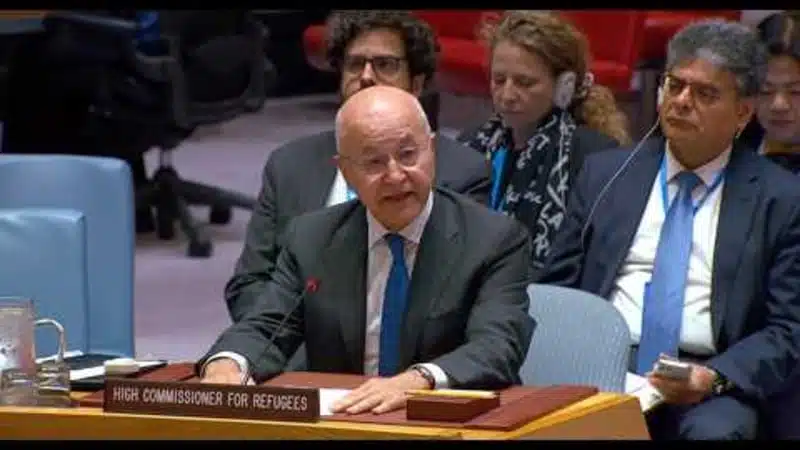


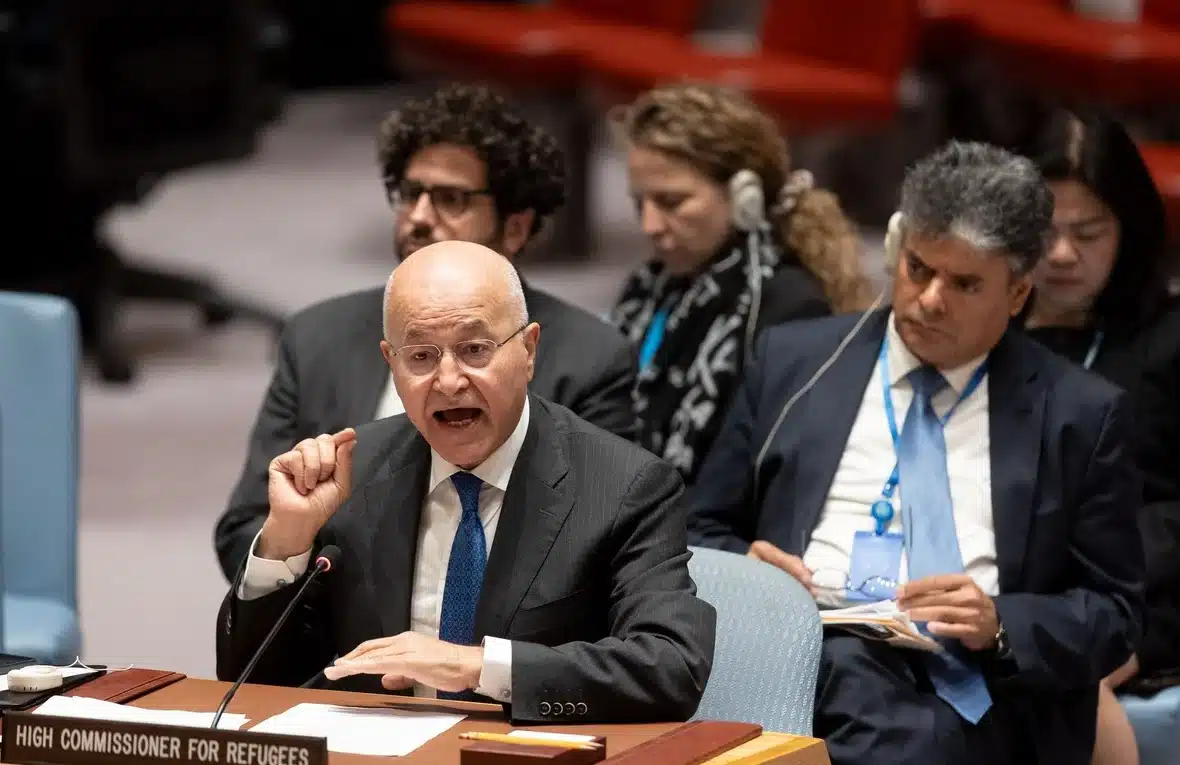
UN High Commissioner for Refugees Barham Salih delivers a speech to the United Nations Security Council in New York. © UN Photo/Manuel Elías
By Barham Salih, UN High Commissioner for Refugees, in New York
Mr. President,
Thank you for the opportunity to address the Security Council.
For more than two decades, this Council has invited the High Commissioner for Refugees to brief on the global state of forced displacement and the situation of refugees and others under UNHCR’s mandate.
I am grateful to France, as President of the Council this month, for the opportunity to deliver my first such briefing as High Commissioner.
Today, more than 117 million people have been forced to flee their homes by conflict, violence, persecution, and other threats to their safety.
This is important because forced displacement tells us something fundamental about the state of our world.
Displacement is rapidly outpacing solutions.
Conflicts are multiplying. Many are becoming more protracted. Political solutions remain elusive. And millions of people who fled what they hoped would be a temporary crisis find themselves displaced for years, sometimes for generations.
This is not only a humanitarian challenge.
It is fundamentally a challenge to international peace and security.
And that is why this discussion belongs here.
Mr. President,
Humanitarian organizations deal every day with the consequences of conflict.
We protect people forced to flee. We support countless countries and communities that receive them. And we work to help people find a way out of displacement.
But humanitarians cannot create peace.
The Charter entrusts this Council with a unique responsibility for the maintenance of international peace and security.
That responsibility matters profoundly to the millions of refugees, internally displaced, and stateless persons that UNHCR serves.
A ceasefire that holds can allow a family to remain at home. A peace agreement can allow refugees to return to their homes.
Mr. President,
We see this very clearly today in Sudan.
Sudan remains one of the largest displacement crises in the world. Millions have been displaced inside and outside the country.
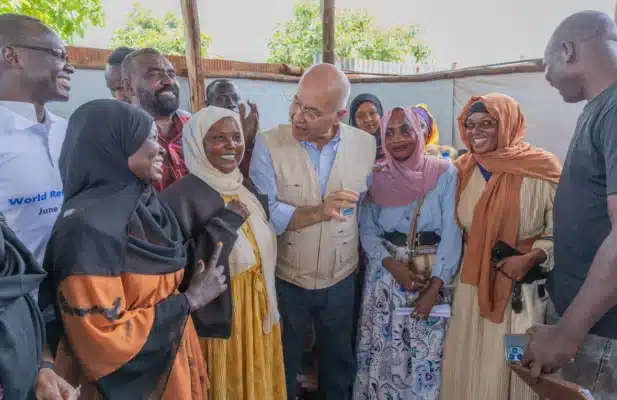
And during my first months as High Commissioner, I visited Chad, Kenya, Ethiopia, and Egypt, and I met Sudanese refugees who had fled horrific violence.
I also saw the extraordinary solidarity of the countries receiving them.
They cannot shoulder the consequences of this conflict alone. Civilians inside Sudan must be protected, and humanitarian organizations need safe and sustained access.
But none of this changes the fundamental reality.
As long as this war continues, people will be forced to flee their homes.
Humanitarian assistance can keep people alive. It cannot give Sudan the peace its people need to return and rebuild.
There is no military solution to the conflict in Sudan. There needs to be a humanitarian truce and to really start a serious dialogue, including with civilians, to pave the way for durable peace.
I urge this Council to use its influence – collectively and individually – to help bring this devastating conflict to an end.
In the Democratic Republic of the Congo, generations have now lived through cycles of conflict and displacement. Their plight is further compounded by the Ebola crisis.
Children are born into displacement. Families flee repeatedly. Communities attempt to rebuild, only to be uprooted again.
The Washington Peace Agreement and the Doha Declaration of Principles, which reference my mandate, offer important openings towards greater peace and stability.
I would like to inform the Council that on 22 June, I chaired the tripartite ministerial meeting on voluntary repatriation.
We, as UNHCR, are committed to maintaining that process, hopefully to successful conclusions. For displaced people, the real test of any peace process is whether it changes conditions on the ground and whether people can return in safety, rebuild, and have confidence that they will not be forced to flee again.
I urge this Council to help sustain that momentum and support the implementation of the commitments already made.
In Ukraine, the war continues to exact an enormous human cost. Civilians continue to be killed and injured, homes and essential infrastructure destroyed, and families uprooted.
Millions remain displaced inside Ukraine, while millions more have sought refuge in other countries.
I visited Ukraine earlier this year and saw both the consequences of war and the extraordinary determination of Ukrainians to rebuild their lives.
Ukraine needs peace. And Ukrainians need solutions.
But recovery cannot wait for the war to end.
In Western Sahara, displacement has persisted for more than half a century.
Generations of Sahrawi refugees have grown up in Tindouf, and camps nearby, facing uncertainty and limited prospects.
Today, conditions are deteriorating, and humanitarian needs remain significantly underfunded. But after more than fifty years, managing displacement indefinitely cannot be the measure of our collective ambition.
The status quo is untenable, unsustainable, and genuinely, truly, inhumane.
There is a growing urgency to move this situation forward. Options exist today that did not years back. Solutions must start with refugees themselves, recognizing their different aspirations and ensuring informed, voluntary choices about their future.
UNHCR is ready to play its part – principled on protection and firmly focused on practical solutions that give Sahrawi refugees genuine agency over their future.
We are working with the special envoy for the Secretary-General, and also with the United States, and other interested parties to help make sure that this process moves forward.
And while some crises have persisted for generations, others risk becoming the protracted crises of tomorrow.
The latest escalation is also very disconcerting and seeing the deepening Yemen’s humanitarian crisis, where civilians continue to bear the brunt of the conflict.
Tens of thousands of people have already been displaced by the recent escalation and hostilities, with thousands fleeing the conflict looking for safety in Djibouti and elsewhere, and more crossings reported to be underway.
In response, UNHCR has declared an initial Level 1 emergency for Yemen, Djibouti and Somalia, enabling the rapid mobilization of resources and staff to scale up our response through cash assistance, shelter and protection.
I join the Secretary-General in calling for the immediate and unconditional release of all UN personnel and other humanitarian workers arbitrarily detained by the Houthi de facto authorities.
Mr. President,
Last week, I was in Mali and Burkina Faso, where more than four million people are forcibly displaced across the region as violence, insecurity, climate shocks, and food insecurity compound one another.
Displacement does not stop at national borders. Nor does the insecurity that drives it.
Across a broad arc from the Horn of Africa and through the Sahel, terrorism and violent extremism are placing growing pressure on States and communities.
These are not simply regional threats. Their consequences for peace and security, development, and displacement should concern us all.
I know from my own country’s experience that confronting terrorism requires sustained international cooperation. And hard-won security gains cannot be lost.
The international community must support States in confronting these threats. But security responses alone will not deliver lasting stability. Security and protection are not competing objectives. They must reinforce one another.
The Sahel is at a critical juncture. There is real urgency – but there is also opportunity.
We must support the States confronting insecurity while investing in people and solutions, so that today’s crisis does not become another generation of conflict and displacement.
And we must not lose sight of the plight of the Rohingya.
More than 1.2 million stateless Rohingya refugees remain in Bangladesh, while conflict and grave protection risks continue in Myanmar.
More than nine years after the mass displacement of 2017, an entire generation of Rohingya children are growing up in exile.
The solution to the Rohingya crisis lies in Myanmar.
Conditions do not currently exist for voluntary return. But that cannot become a reason for accepting the status quo.
I urge the Council to remain actively engaged in efforts to end the conflict and create the conditions in Myanmar in which Rohingya refugees can eventually return voluntarily, safely, and with dignity as nationals.
Mr. President,
These situations are profoundly different.
But they illustrate the same fundamental truth.
When peace fails, people move.
And when they do, they must be able to find protection.
I appeal to this Council: use your political influence to end the conflicts and sustain peace processes. Protect civilians and uphold international humanitarian law. Preserve asylum and uphold the principle of non-refoulement. Invest in solutions from the outset. And support countries that host refugees and those to which they return.
This is at the heart of the 1951 Refugee Convention, whose seventy-fifth anniversary we mark this year.
Seventy-five years ago, in the aftermath of a world shattered by war, nations established a simple and vital principle: people forced to flee persecution would be protected and would not be returned to danger.
During my first missions as High Commissioner, I met people who crossed borders not because they wanted to become refugees, but because staying at home became impossible.
That is what asylum is for.
States have the right to manage their borders. The Convention does not diminish State sovereignty in applying its laws. It is one of the most practical instruments of protection the international community has created.
And asylum has another purpose that is particularly relevant to this Council.
Asylum is a bridge to peace.
It protects people when peace has failed, while preserving the possibility that, when conditions allow, they can return home voluntarily, safely, and with dignity.
Today, asylum systems are under strain. Those pressures must be addressed. But they cannot become a reason to retreat from the fundamental principles of refugee protection.
The Refugee Convention has endured for seventy-five years and has delivered for humanity because its fundamental purpose remains necessary and because it offers a response to contemporary challenges. Our responsibility remains to ensure that these principles are preserved and applied in a proper way so that it can deal with the challenges of the future.
Mr. President,
Protecting people when they are forced to flee is indispensable.
Protection is not an objective in itself, and it must continue until solutions are found.
We cannot – we should not – accept an ever-expanding system of permanent displacement as inevitable.
Refugees have told me again and again that they do not want their lives to be defined by displacement.
That is the purpose of the 50by35 Vision that I have launched earlier this year.
Our ambition is to reduce by half by 2035 the number of refugees in long-term displacement who remain reliant on humanitarian assistance.
It is ambitious.
I acknowledge it is a highly ambitious goal.
It must be.
But we have to recognize keeping people alive year after year while they remain unable to rebuild their lives cannot be our end goal.
Every context will differ. We must expand opportunities for inclusion and self-reliance while accelerating progress towards solutions – voluntary return where conditions permit, third-country pathways, and opportunities for local integration or alternative legal status.
And we need to work differently.
Refugees and returnees need to be included in national development plans and systems. Development financing must support host communities and countries of return.
And solutions must be part of recovery and peacebuilding from the outset — not as an afterthought.
I saw this recently in Syria.
Since December 2024, some 3.8 million Syrians displaced abroad or within their country have returned to their homes.
Their determination to rebuild is unmistakable. But determination alone cannot rebuild a country.
Syria needs international engagement and investment in recovery so that those who choose to return can stay and rebuild.
I want to remind ourselves: for more than a decade, Syria was a headline about violence, displacement and onward movement. Now, Syria has the opportunity of seeing large numbers of refugees and displaced people going back to their homes and rebuilding their lives. We must not lose that opportunity. We must be engaged to make sure that this is realized.
The same is true in Afghanistan.
By the end of this year, we expect nearly eight million Afghans to be returned to their areas, admittedly many in adverse circumstances, not entirely voluntary.
Many returned amid a severe humanitarian situations and significant restrictions, especially on the rights of women and girls, to communities already struggling with poverty, limited services, and few economic opportunities.
Return, I want to say, is an event. A solution is what comes after.
People need to rebuild their lives in safety and dignity, support their families, and have a reasonable prospect to remain in their homes.
That requires humanitarian assistance, but also development investment, livelihoods, and functioning national systems.
And above all, where displacement is caused by conflict, it requires a political solution.
That is the shift at the heart of the 50by35 vision: from managing displacement indefinitely towards resolving it.
And I also have to say, UNHCR must also adapt and change too.
We are reforming our organization to make it leaner, more agile, and more focused on the field and directing our resources where they can deliver the greatest protection and the most solutions.
Working to the aims and objectives of UN 80 and within the humanitarian reset, we are engaged in serious fundamental reforms to make sure our organization is able to deliver effectively, efficiently, and with accountability.
Reform is not an end in itself. It is about ensuring UNHCR can deliver its mandate in this radically changed world.
Mr. President,
Humanitarians will continue to do our part.
We will protect people forced to flee. We will stand with the countries and communities that receive them. And we will pursue every opportunity for solutions.
But we must also be careful about how we define success.
Success cannot be that we become better at keeping people alive through another year of war.
It cannot be that a refugee camp established in response to an emergency is still there fifty years later.
And it cannot be that children inherit displacement from their parents.
Success must ultimately mean creating the conditions in which people no longer need us.
Seventy-five years ago, the Refugee Convention established a promise to protect people when peace fails.
We must keep that promise.
But our collective ambition must also be greater: to prevent displacement where we can, resolve it where it has occurred, and create the conditions in which people can rebuild their lives in safety and dignity.
Ultimately, the most durable solution to forced displacement is peace.
And you, around this table, carry a unique responsibility to help make peace possible.
For the millions of people forced from their homes – and the millions more who should never have to flee – I urge this great Council to use that responsibility.
Thank you.
Watch the full speech: