


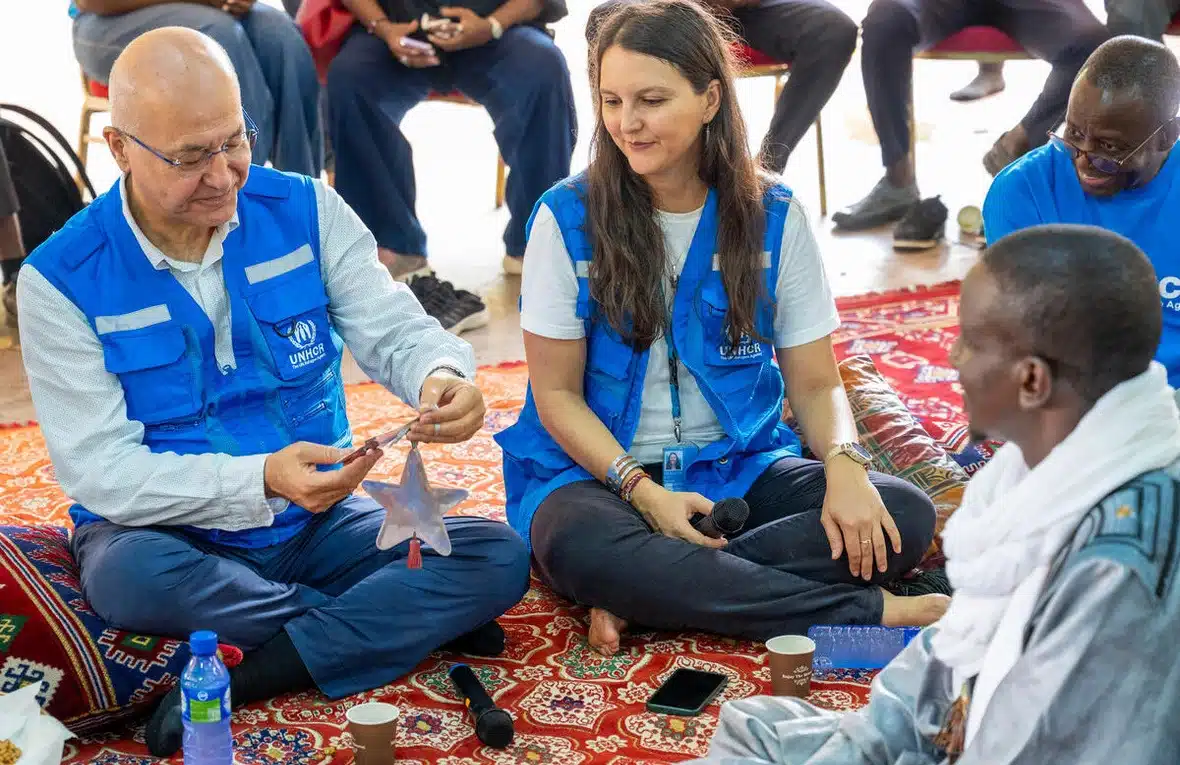
© UNHCR/Virginie Blanche Wend Kuni Zoubere
BAMAKO/OUAGADOUGOU – Concluding a visit to Mali and Burkina Faso, UN High Commissioner for Refugees Barham Salih urged greater investment in life-saving protection and lasting solutions for forcibly displaced people and the communities hosting them across the Central Sahel.
Insecurity remains the primary driver of forced displacement across Burkina Faso, Mali and Niger. The total number of forcibly displaced people across the three countries has nearly doubled since 2020, reaching 3.8 million people by 31 July 2026. Of these, more than 818,000 are refugees and asylum-seekers.
Forced displacement is also extending beyond the Central Sahel. By July 2026, over 460,000 refugees and asylum-seekers fleeing violence in Burkina Faso had sought safety in neighbouring countries. Mauritania is also hosting some 169,000 Malian refugees, underscoring the wider regional impact of the crisis. Across the Sahel, refugees are also undertaking dangerous journeys, often in tandem with migrants, towards North Africa and Europe.
“The Central Sahel is a region of consequence. We cannot be indifferent. The challenges here – including insecurity, climate pressures and forced displacement – have implications well beyond the region,” Salih said. “Failing to remain engaged today risks creating far greater challenges tomorrow. But what is often missing from the headlines is the opportunity I saw. Many of the people I met were focused on rebuilding their lives. With access to education and economic opportunities, that becomes possible. These are solutions taking shape, but they need investment well beyond the humanitarian response to reach scale.”
The stakes are particularly high for young people. More than half of registered refugees and asylum-seekers in the Central Sahel are under 18, yet only one-third of refugee children have access to primary and secondary school. Without greater access to education and opportunities, forced displacement risks shaping a generation.
In Koro, Mali, Salih saw the emergency response from UNHCR, the UN Refugee Agency, in an area that had received around 86,000 refugees from Burkina Faso as of July 2026. In Timbuktu, where more than 40,000 Malians have returned after years of displacement, he met families slowly rebuilding with support from authorities, UNHCR and partners.
In Kaya, Burkina Faso, he visited agricultural and connectivity initiatives where UNHCR is supporting national efforts to strengthen livelihoods, resilience and self-reliance for forcibly displaced people and host communities. He also met Malian, Chadian and Mauritanian refugees living and working in Ouagadougou.
Across Mali and Burkina Faso, governments and host communities have demonstrated remarkable solidarity, continuing to welcome people forced to flee despite significant pressure on local services, infrastructure and resources.
Mali has maintained its longstanding commitment to asylum and international protection, including through the prima facie recognition of refugees arriving from Burkina Faso and Niger. Burkina Faso continues to provide refugees with access to essential rights, including education and livelihood opportunities, while advancing their inclusion in national social protection systems.
Salih discussed how to build on these efforts with government representatives, humanitarian and development partners and donors, including the need for greater engagement from international financial institutions and the private sector to scale solutions.
“What impressed me was the commitment of governments and communities to protecting and including people forced to flee, ensuring they can access services and opportunities alongside the communities hosting them, even in very difficult circumstances,” Salih said. “The vast majority of refugees from Mali and Burkina Faso are hosted by neighbouring countries across the region. The people I met want the same things people everywhere want: for their children to go to school, to work and to build a better future.”
With UNHCR’s response in the Central Sahel only 25 per cent funded, critical programmes and services such as documentation, shelter, livelihoods and economic inclusion are being affected as needs mount. Yet UNHCR remains present across the region, including in border and hard-to-reach areas, working alongside governments and communities to protect and assist people forced to flee and advance solutions.
Media contacts:
- In Bamako, Mahamadou Diallo, diallmah@unhcr.org, +223 79 34 00 41
- In Ouagadougou, Laurence Bron, bronl@unhcr.org, +226 54 00 67 00
- In Dakar (regional), Fidelia Bohissou, bohissou@unhcr.org, +221 77 569 91 60
- In Geneva, Eujin Byun, byun@unhcr.org, +41 79 747 8719


