

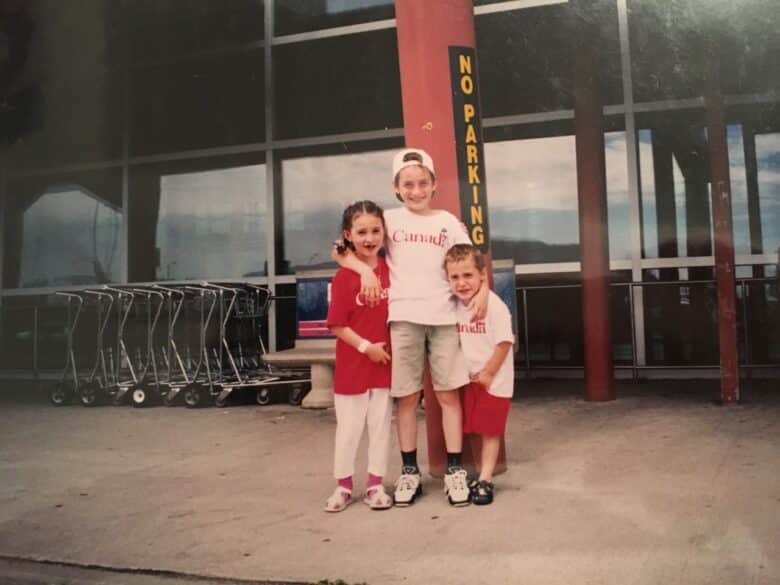
Leonora Abdullahu, left, stands with her brothers. The family arrived to Canada from Kosovo as refugees in 1999 after spending nearly two months in refugee camps in Macedonia, 2000. Photo Credit: Leonora Abdullahu.
By Zeba Tasci in Ottawa, Canada
When Leonora Abdullahu thinks back to her arrival in Canada, some memories are clearer than others.
She was five years old when she arrived with her parents and two brothers, part of the first group of refugees from Kosovo accepted by Canada during the 1999 Kosovo war. After spending nearly two months in refugee camps in Macedonia, the family boarded a plane to Canada.
They eventually settled in Thunder Bay, Ontario, where a local church group helped several newly–arrived refugee families begin rebuilding their lives.
For Leonora, the memories are mostly fragments: the happy moments, the excitement of being with her family, and the anticipation of something she had not yet experienced.
Like going to school for the first time.
“I remember back home, my older brother had started school and I hadn’t yet,” she says. “I was very excited to start school.”
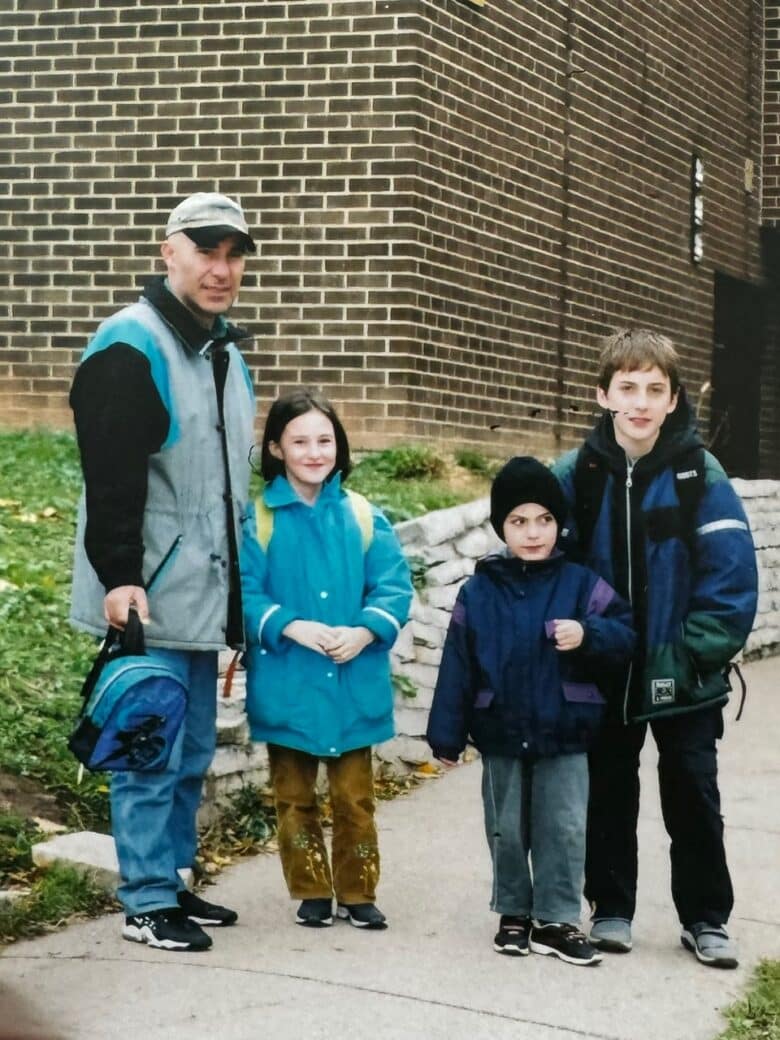
Leonora, second from left, stands with her father and brothers on their way to school, 2002. Photo Credit: Leonora Abdullahu.
However, she did not speak English, was in unfamiliar country, and had never been to school before.
It was a rough start to Grade 1. Her parents still tell the story of how she cried at school drop-off for an entire month. Her older brother, three years her senior, attended the same school, and teachers would sometimes bring him to her classroom to help her feel more comfortable.
Eventually, though, the little girl with tears in her eyes found her footing. Education would become one of the defining threads of her life.
Finding her way without a roadmap
After about a year in Thunder Bay, Leonora’s family moved to Hamilton, Ontario, joining other Kosovar families who had begun settling in Southern Ontario in search of greater employment opportunities.
Hamilton became home.
Leonora excelled in school and went on to study Chemical Biology at McMaster University. But university brought a realization she had not encountered before: succeeding in school was not only about academic ability. Students arrived with vastly different levels of preparation, resources, and knowledge about how the education system worked.
At university, she found herself surrounded by students from different communities and backgrounds, some of whom had parents or older siblings who could guide them through applications, course selection and career decisions.
Leonora did not have that same roadmap.
“I remember feeling a little bit at a disadvantage,” she says. “I felt like I was really going into it blindly.”
Her parents had never attended university in Canada. Questions that might have seemed straightforward to other students—what courses to take, how to apply, how to fund an education or what came after an undergraduate degree—were new territory for her family.
She relied on guidance counsellors, teachers, friends and her own determination. Financial support was another important piece. She applied for grants and other funding, including programs for low-income students, which helped make university possible.
Looking back, Leonora recognizes how much of her experience was shaped by being a first-generation university student.
“There were a lot of challenges in that, especially when it came to navigating university and figuring things out along the way,” she says.
Her experience has also shaped the way she thinks about community. Today, younger members of Hamilton’s Albanian community have access to something Leonora did not: people who have already navigated the system and can help show them the way.
A mentor who saw more than a résumé
After McMaster, Leonora pursued a PhD in chemistry at McGill University, specializing in nucleic acid chemistry, a field focused on understanding the chemistry of RNA and DNA and exploring how this knowledge can be applied to the development of new therapeutics.
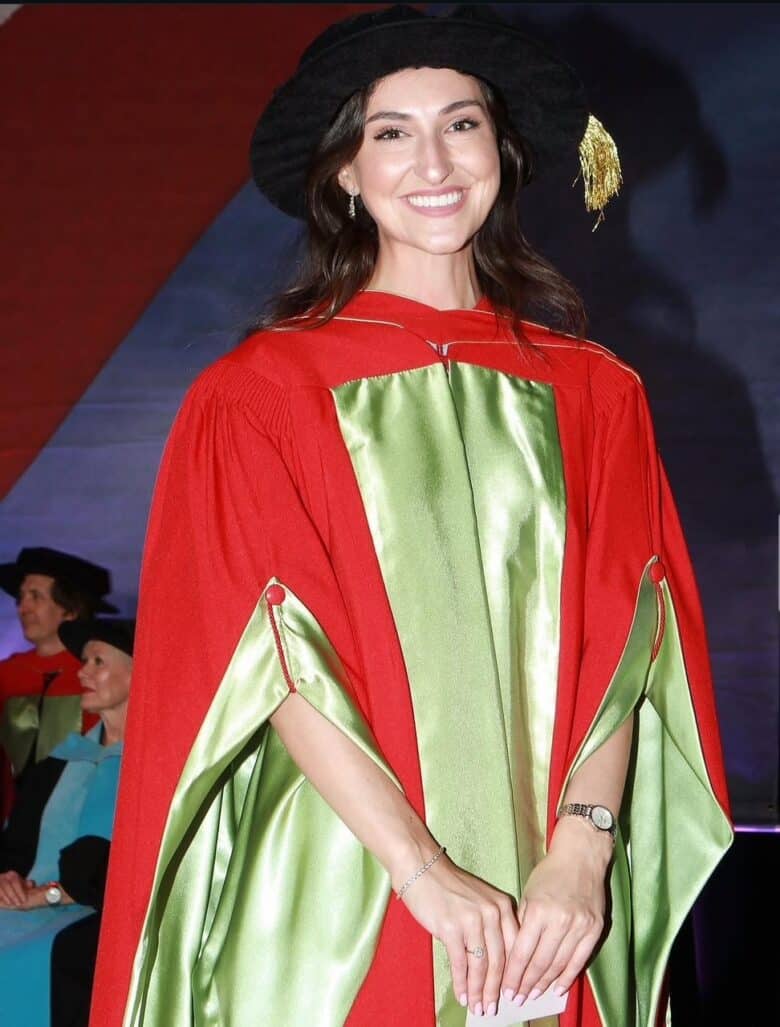
Leonora at her PhD graduation, McGill University, 2022. Photo Credit: Leonora Abdullahu.
The decision to pursue graduate school felt like a natural next step. Her undergraduate co-op placements had taken Leonora to various laboratories around the world, including Berlin, and New York City. She was thrilled by the opportunity to experience different research environments and collaborate with scientists internationally. These experiences broadened her perspective on the field and reinforced her interest in pursuing a PhD, which she knew would open doors in the scientific fields she wanted to explore.
But the most important decision she made during her PhD may have been choosing her mentor.
McGill’s graduate chemistry program gave students the opportunity to meet with different professors and explore different labs before deciding who they would work with. During one of those interviews, Leonora met Professor Masad Damha, an RNA researcher who would become her PhD supervisor and a mentor she continues to turn to today.
What Leonora remembers most was his first question.
“Leonora from Kosovo, tell me about this experience!”
Her refugee background had been mentioned briefly in her application. But rather than moving immediately into a discussion of her scientific credentials, Damha wanted to know about her story.
For Leonora, the moment stood out.
“I always remember feeling grateful and surprised,” she says. “I felt like he was really invested in my application and my background.”
That relationship became transformative. Damha did not simply encourage his students to follow a predetermined academic path. He took the time to understand their individual strengths and interests and helped Leonora recognize that she was interested in exploring career opportunities beyond academia.
That eventually led her to the pharmaceutical industry.
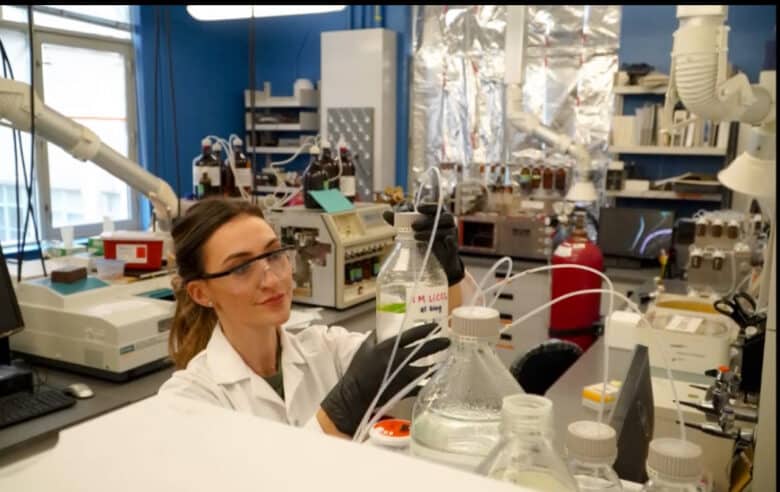
Leonora working in the Damha Lab, 2019. Photo Credit: Leonora Abdullahu.
From RNA research to innovation
Today, Leonora works remotely for Eli Lilly and Company, a pharmaceutical company, where she focuses on external innovation.
Her scientific training remains central to her work, but her role has evolved beyond the laboratory. She identifies promising research and emerging technologies being developed by startups, biotechnology companies, independent research labs and academic groups, evaluating opportunities to support their development through partnerships, funding and investment.
Her work began with a focus on RNA technologies and has since broadened to include therapeutic areas such as diabetes and obesity.
RNA therapeutics was a particularly exciting field in which to build a career. When Leonora began her PhD, RNA was still unfamiliar to many people outside the scientific community. By the time she graduated in 2021, the COVID-19 pandemic had brought RNA vaccines into everyday conversations and increased public awareness of technologies involving RNA, genetic diseases and gene editing.
“It was a very promising field to be working in at the time,” she says.
For Leonora, the journey from a refugee child who initially cried at school to a scientist working at the forefront of pharmaceutical innovation is not something she describes as a carefully mapped-out plan.
Much of it came from taking the next opportunity, finding people who could offer guidance and learning to navigate systems that were unfamiliar to her family.
Building a community
Alongside her academic and professional journey, Leonora has remained deeply connected to the Albanian community across Canada.
Her parents made preserving their language a priority from the moment the family arrived. At home, they spoke Albanian rather than English, knowing that Leonora and her brothers would encounter English everywhere else, in school, with friends and throughout Canadian life.
As a young person, Leonora began volunteering with the local Albanian community organization (Albanian Society of Hamilton). Because she was fluent in Albanian and comfortable speaking publicly, she began by serving as an emcee at community events.
When she went to university, she became involved as a student representative.
The organization was working to bring younger people into community life and to help a new generation maintain a connection to its heritage.
For Leonora, it became a place of belonging, not only for young people, but for her parents and other families who had rebuilt their lives in Hamilton.
“The goal has always been to bring families together and create a welcoming space where people can connect, build relationships and feel a sense of belonging,” she says.
Her involvement continued for years. She eventually served as vice-president and, after returning to Hamilton following several years away for school and work, was elected president.
The timing was challenging. She married, became pregnant and welcomed her daughter during most of her two-year term as president.
Still, she was proud to watch the organization continue to grow.
Passing it on
Today, Leonora sees community involvement differently than she did as a child.
She and her husband, who also came to Canada as a refugee from Kosovo, now have a young daughter. They want her to grow up knowing not only that she is Canadian, but what it means to be Albanian.
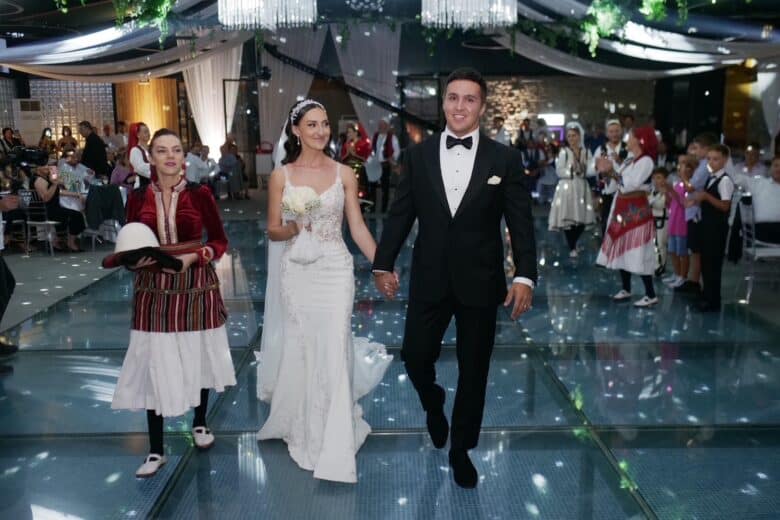
Leonora and her husband, Ali, on their wedding day, 2024. Photo Credit: Leonora Abdullahu.
That means speaking Albanian at home, participating in language programs and keeping traditions alive.
“I’m sure we’ll send her to the same Saturday school I attended, to learn the language,” Leonora laughs.
“She is going to learn English,” Leonora says. “She’s going to be surrounded by English. But it’s important to us that she is fluent in Albanian as well.”
The family also hopes to continue returning to Kosovo. Leonora first went back with her mother and brothers in 2002, after the situation there had stabilized. As a child, she spent most of her summer holidays immersed in the language and culture.
This summer, her daughter made her first trip.
She met Leonora’s family and her husband’s family, experiencing a place that has been part of her parents’ stories even though she was born in Canada.
For Leonora, those connections are about more than preserving traditions. They are about giving her daughter a sense of identity and belonging.
Remembering where the story began
There is one unexpected piece of Leonora’s childhood that has helped her understand her family’s journey in a new way.
A friend, herself a refugee who arrived in Canada at a young age, is now pursuing a PhD at Carleton University researching Kosovar refugees who came to Canada in 1999.
While going through archival material, she discovered an old newspaper article about the refugees who had arrived in Canada.
Leonora was in it.
She had never known the article existed. Seeing photographs and accounts of her family from that time gave her an opportunity to look back at an experience she had largely remembered through the eyes of a child.
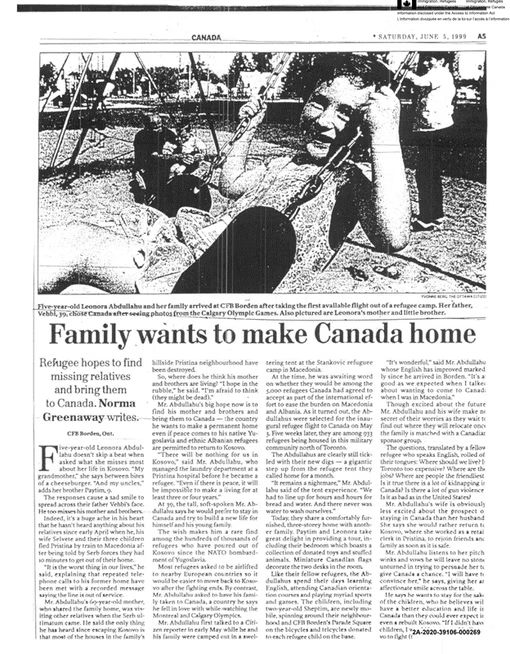
Photo Credit: Krenare Recaj, Carleton University.
“The five-year-old girl in those records could not have known what the next two decades would bring,” says Leonora. Her life in Canada would include university, a PhD, a career in science, leadership in her community, marriage and motherhood.
But the story that began with displacement has become one of rebuilding and connection.
Leonora’s parents came to Canada seeking safety and a chance to rebuild their lives. Their daughter grew up between cultures, learned to navigate institutions her family had never encountered before, and found mentors who helped her recognize possibilities beyond the paths she initially imagined.
Now she is helping create those possibilities for others.
When asked what advice she would offer newcomers beginning their own journey in Canada, Leonora encourages them to remain open to opportunities, even when they lead in unexpected directions.
“Starting over in a new country and navigating unfamiliar systems can be intimidating, but you don’t need to have everything figured out from the beginning,” she says. She encourages newcomers to take things one step at a time, seek out supportive people, and not be afraid to explore different paths. Just as importantly, she believes in embracing Canadian culture and appreciating all the opportunities that come with building a life here.
The community that once helped her family settle in Canada is one she now helps strengthen. The language her parents insisted she speak is one she is passing to her daughter. And the educational guidance she once had to find for herself is something she hopes younger generations will no longer have to navigate alone.
Her journey is, in many ways, a story about what happens after resettlement: not simply arriving somewhere safe, but building a life, finding belonging and eventually helping others find it too.