

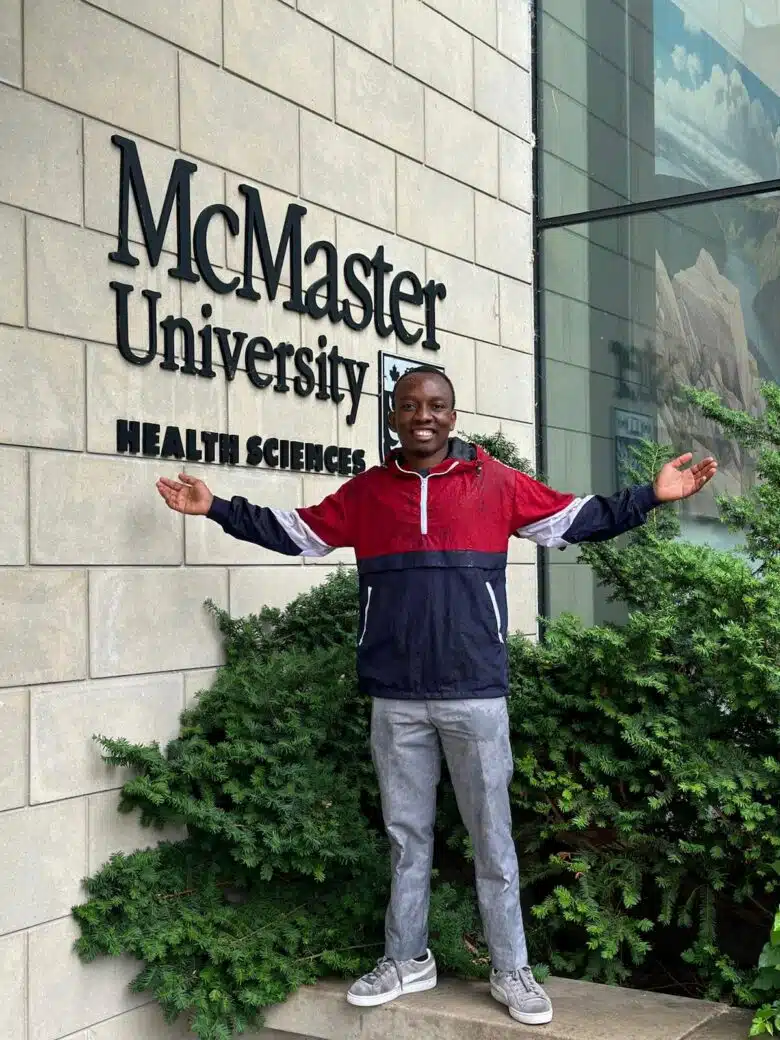
Landry Kalembo in front of the McMaster University Health Sciences building in Hamilton, Ontario.
By Zeba Tasci in Ottawa, Canada
Landry Kalembo’s experience of displacement is driving him to ask whose stories are captured in health research, and what happens when they aren’t.
For academic Landry Kalembo, some of the questions driving his research began long ago.
Born in the Democratic Republic of the Congo (DRC), Landry was 10 when his family fled to Uganda. He remembers walking for miles, eventually taking a bus toward Kampala. He remembers the paperwork, too.
As his family navigated the Ugandan asylum process, Landry accompanied his parents to appointments and spent hours in offices while they completed forms and interviews.
“I remember my dad doing a lot of interviews. I remember people. I remember going to several offices,” he says.
One memory has stayed with him: watching his father work on a computer, filling out paperwork while Landry sat behind him.
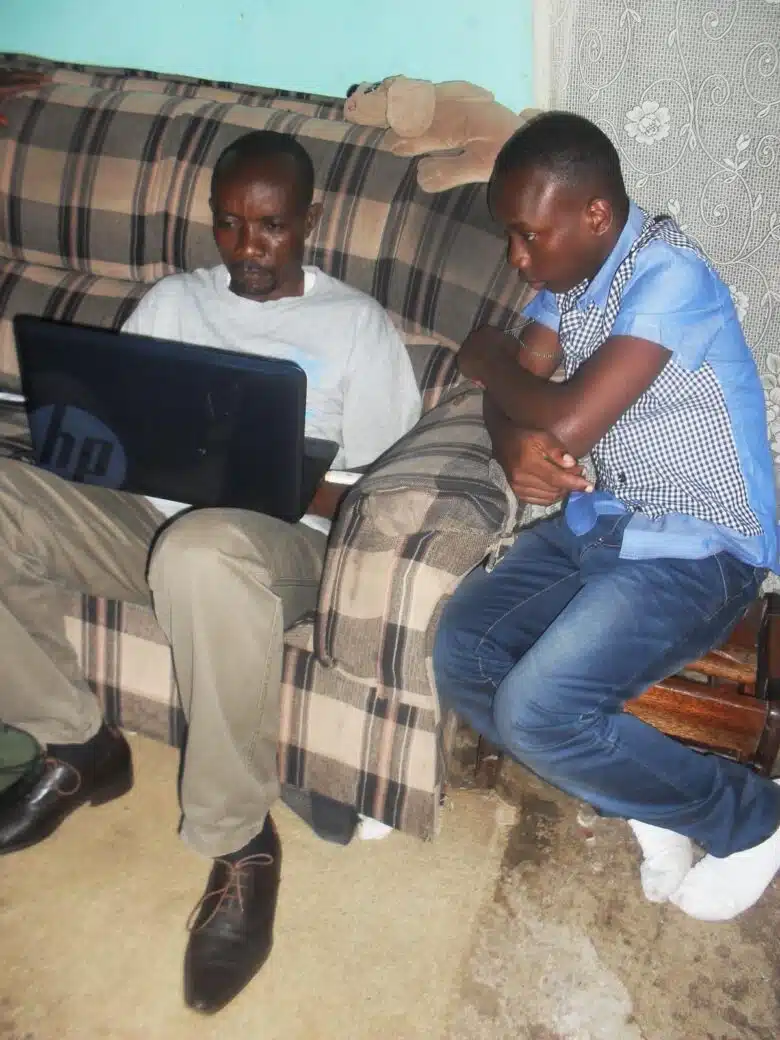
Landry watches his father work, Kampala, Uganda.
“At the time, you don’t understand the intensity of it. Now, as a grown up, I’m like, wow, that was a very stressful, very intense time for them.”
Those early experiences would eventually shape the questions he asks today, about whose experiences are documented, whose voices are heard and what can be missed when people are reduced to assumptions about where they come from.
From displacement to education
In the DRC, Landry had spoken Swahili and French. In Uganda, he learned Luganda and eventually enrolled in English classes offered by the Jesuit Refugee Service.
The classes were designed primarily for adults, but Landry was determined to learn English. He also wanted an opportunity to continue his education.
“I actually wanted to learn English. So I went to that adult school.”
His teachers recognized his potential. After he completed the course, the Jesuit Refugee Service sponsored his education, making him their first refugee-sponsored child.
He went on to attend primary and secondary school in Uganda, eventually becoming one of the top students in his class. When his family’s refugee process was successful, they began their journey to Canada.
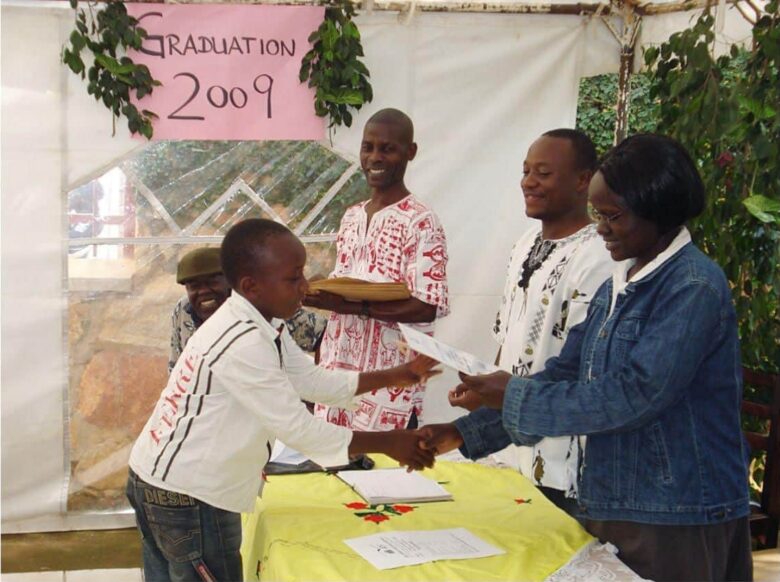
Landry, a young student, proudly received his certificate from JRS after completing his English language classes, Kampala, Uganda. Photo Credit: Susi Moeller, JRS.
Finding home in Ottawa
The family arrived in Montreal before eventually settling in Ottawa.
Eventually, they moved to the Heron Gate-Heatherington community in the south of the city. A densely-populated neighbourhood, the area includes a large population of newcomers and immigrants — along with negative stereotypes about its residents.
For Landry, it was home.
“You’d see people from all over the world. You’d see people from all religions,” he says. “That was one thing that I appreciated. So at least despite the outside, how people see it, I saw the community.”
He attended Ridgemont High School, a local school that reflected the diversity of the community. Here, he made lifelong friends and eventually became student council president.
But he also encountered assumptions about where he came from.
While applying for a job at a community centre, someone looked at his résumé and questioned whether he really lived in the neighbourhood.
“They said, ‘Wow, this is a wonderful CV. Are you sure you live in here?’”
Later, someone told him he was “too smart” to attend Ridgemont.
Landry remembers those moments, but he sees them as evidence of how easily stereotypes can obscure a person’s potential.
“I’m proud to grow up from Heron Gate. I’m proud to have gone to a school that was stereotyped. And I’m proud to have made it well and prove people wrong.”
For him, where someone comes from should never determine how far they can go.
“Education is education,” he says. “We make our choices and we also get support.”
That experience, of being seen through assumptions while knowing there is more to a person’s story, would become relevant again as Landry began to discover his path.
A personal experience becomes a research question
Landry’s interest in health began while he was growing up in the DRC, where he saw communities trying to understand illness and its causes.
He later studied Interdisciplinary Health Sciences at the University of Ottawa. It was at this time his academic pursuits intersected with personal tragedy.
His father, whom Landry describes as exceptionally healthy, was diagnosed with liver cancer. Landry spent more time at the hospital while continuing his studies and volunteering at The Ottawa Hospital.
The experience changed the questions he was asking. Rather than focusing only on treating illness, he became interested in prevention — and in understanding the circumstances and experiences that can shape whether people become sick in the first place.
“How can we go to preventative medicine? How can we go to an area where we understand why people fall sick rather than trying to solve the cases?”
Sadly, his father died while Landry was completing his undergraduate degree. Landry continued his studies, graduating in 2021 and completing a master’s degree in health sciences focused on food insecurity, stress and health during pregnancy.
But another experience was never far from his mind: forced displacement.
His own journey had shown him how profoundly circumstances can shape a person’s life, from access to education and health care to the way other people see them.
It also raised a broader question: what happens when those experiences are not fully understood or represented in the research used to shape health care?
What happens to health when people are forced to flee?
Today, Landry is a global health doctoral candidate at the Mary Heersink School of Global Health and Social Medicine at McMaster University in Hamilton, Ontario. His research asks how forced displacement affects health outcomes.
He is particularly interested in understanding how people’s lived experiences, including where they live, the resources available to them and the disruptions caused by displacement, can influence their health trajectory and access to care.
Forced displacement can take different forms. Refugees and asylum-seekers cross international borders, while internally displaced people remain within their own country. Some may be displaced repeatedly, sometimes remaining close to the conflict or disaster that forced them from their homes.
These experiences can shape health in very different ways.
He is particularly interested in the underrepresentation of internally displaced people, who make up more than half of all forcibly displaced people, and of refugees living in countries that host large populations but receive less attention in global research.
Much of the public conversation about refugees focuses on people arriving in wealthier countries such as Canada, the United States, the United Kingdom and Australia. But many refugees live in countries with fewer resources, where health systems may already be under significant strain.
A refugee living in Canada may face very different circumstances from one living in Uganda. An internally displaced person in the DRC may face different challenges again.
His goal is to understand those differences so that health interventions can respond to specific needs.
“I don’t want an intervention that addresses all forcibly displaced people as one.”
His research also looks at how infectious diseases are diagnosed and managed in the context of forced displacement. Displaced people may face financial hardship, food insecurity, unstable housing, disrupted livelihoods and long journeys to health facilities, while health workers may be operating within systems already facing shortages and infrastructure challenges.
Landry describes displacement as a “structurally produced clinical context of inequality.”
At the same time, he sees health workers finding creative ways to help. Some draw on community networks. Others raise money to help patients afford medication or improvise when resources are limited.
Landry wants to understand what works, but not simply celebrate these efforts as examples of “resilience.” He questions why people should have to be extraordinarily resilient in the first place.
“We often don’t have to focus on negatives. We can also focus on what works and try to see how we can develop that further.”
This approach is often referred to as appreciative inquiry, focusing on what is already working and asks how those practices could be strengthened or replicated.
Ultimately, he hopes this work can contribute to better preparedness for future outbreaks, emergencies and other public health disruptions.
Giving back
Research is only one part of Landry’s life in Canada.
He has volunteered with Parkdale Food Centre in Ottawa for more than a decade and served as a board member, supporting work around food insecurity. He is also involved in community and student initiatives using mentorship, sport, spoken word poetry, and writing, while serving in leadership roles including Co-Chair of the Global Health Student Liaison Group, Vice President of the African & Caribbean Graduate Student Association at McMaster University, and previously as President of the Organization of Masters Students in Interdisciplinary Health Sciences at the University of Ottawa.
For Landry, these activities are part of building a life after displacement.
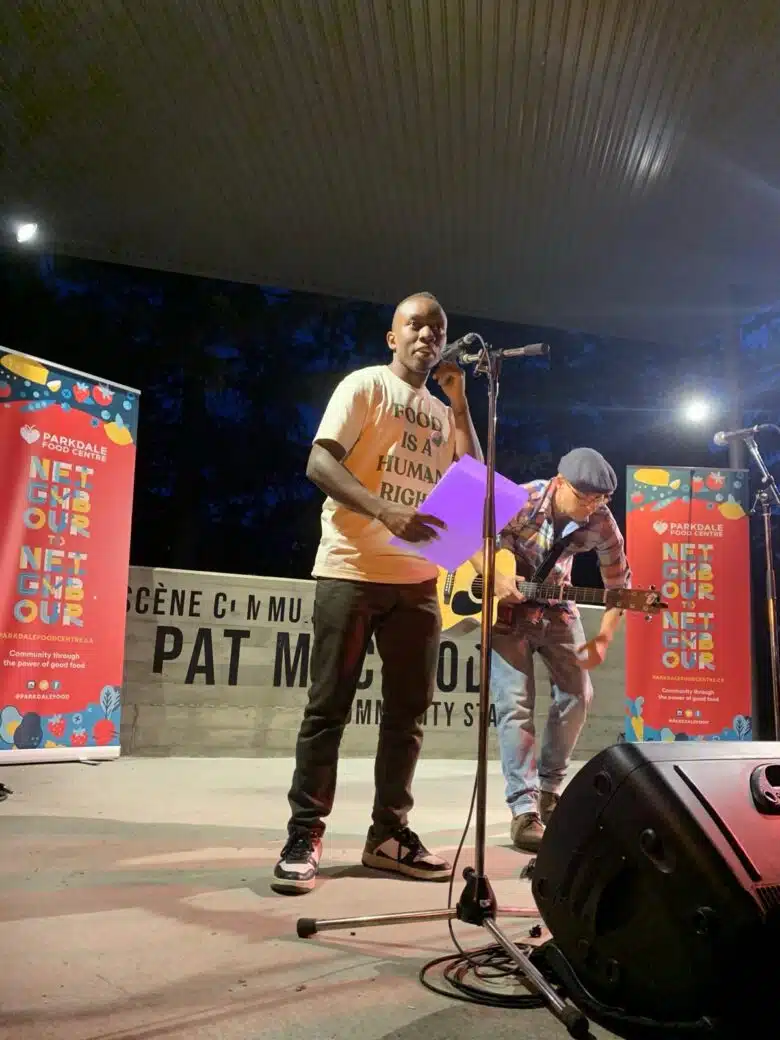
Landry speaks at a ParkDate Food Centre event, who hosted their first annual Right to Food Day in Ottawa in October 2022.
He does not want his refugee experience to become the only lens through which his life is viewed.
“I’ve never been ashamed of that. I appreciate that,” he says. “But sometimes that becomes part of one thing and can overshadow the other amazing work that people do.”
Through community activities, he hopes to create opportunities for young people to build relationships, develop confidence and see themselves as active members of their communities.
Carrying the journey forward
Landry’s journey has taken him from the DRC to Uganda and eventually to Canada.
Along the way, he learned new languages, navigated new school systems, experienced the loss of his father and found a path into health research.
His story has also reinforced a lesson that now runs through his research: a person’s circumstances can tell you something about what they have experienced, but they do not tell you everything about who they are or what they can become.
Today, Landry is bringing that perspective to questions about forced displacement and health. He is asking whose experiences are represented in research, whose are overlooked and how a better understanding of lived experience can lead to more useful health interventions.
His hope is that better evidence can lead to better policies, stronger health systems and interventions that reflect the realities of the people they are meant to serve. As he completes his PhD next spring, Landry hopes to pursue a career as a professor, researcher, and educator while collaborating with global health organizations working to support displaced and vulnerable populations across the world. Through research, teaching, and policy engagement, he aims to generate evidence that advances health equity and helps ensure that the voices and experiences of marginalized communities inform the decisions that affect their lives.
For a researcher whose work is rooted in his own journey, it is a question that has come full circle.