


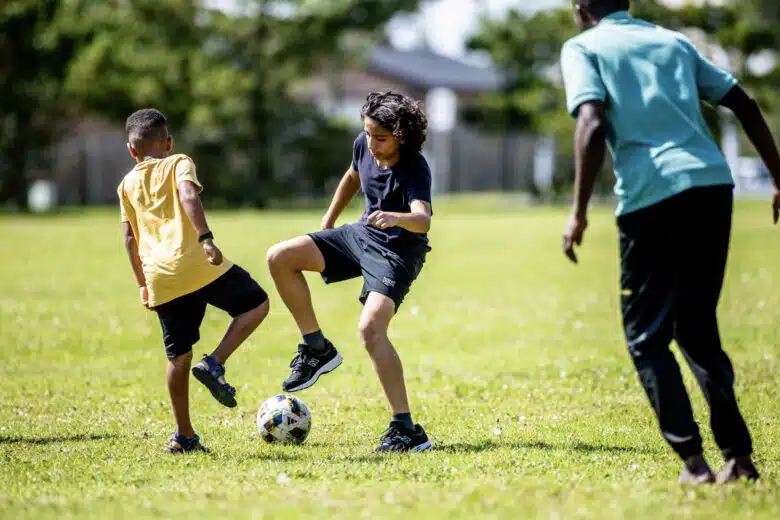
Children take part in a soccer game during Free Play for Kids’ “Welcome to Play” program, which helps newcomer and refugee children build friendships, confidence and a sense of belonging as they settle into their new communities.
© Free Play for Kids
By Zeba Tasci in Ottawa, Canada
When families arrive in a new country after fleeing conflict, persecution or uncertainty, the world they once knew feels far away — and the challenges of building a new life can feel overwhelming. For children and parents alike, the early days of resettlement can be defined not by relief alone, but by deep transition: new languages, new routines, and the invisible weight of adjusting to a place that should feel safe, but is still unfamiliar.
In Edmonton, Free Play for Kids’ Welcome to Play program creates a space where the simple act of play becomes something much more profound — a bridge to healing, connection and belonging. Through fun, active, trauma-informed activities, Welcome to Play supports recently arrived refugee and newcomer children, youth and parents as they navigate the first steps of their settlement journey. Every day, staff welcome families from temporary hotels and transitional housing, guiding them to recreation centres, community spaces, museums and parks where children can laugh, explore and make friends in a supportive and inclusive environment. The program also connects youth to leadership pathways and offers opportunities for parents to engage and connect with community resources.
For families like Juan’s, the impact of this welcome goes beyond the play itself — it touches transformation. Three years after arriving in Canada from Mexico, Juan’s son Elias was initially shy and hesitant to engage. But through connections first made in after-school and resettlement-focused programming, he found new confidence and a sense of belonging.
Juan, a devoted father and avid soccer fan, watched his son begin to change in ways that delighted and surprised him:
“I love soccer — it’s my favourite sport. But Elias was never fully into it. He was always kind of following his own path… He liked the idea [of joining a team], got into it, and now he’s loving it.”
For Juan, the value of play — and especially the chance to be part of a soccer team — extends far beyond sport. He sees it as a space where children learn responsibility, teamwork, and how to work with others. He also highlights the role of caring coaches who support the kids not just in sport, but in life. Through these experiences, Elias began to move away from screens and isolation, trying new things and spending time with peers — a visible sign of growth that filled Juan with hope.
Stories like Juan’s reflect a pattern seen time and again in Edmonton’s newcomer communities — where sport and play can unlock potential in ways that ripple far into a child’s future.
One of the most remarkable examples is Canadian-born soccer star Alphonso Davies, whose own journey from newcomer child to international athlete began in a free after-school soccer program very much like Welcome to Play.
Davies, born in a refugee camp in Ghana and resettled in Edmonton with his family at age five, first played organized soccer in a local free soccer league that removed barriers to participation and helped him connect with peers and coaches in his new home city. This early access to organized play helped ignite his love of the game and set him on a path that would lead to professional soccer with Vancouver Whitecaps, FC Bayern Munich in Germany and the Canadian national team — demonstrating how inclusive, community-based play can spark confidence and open doors for children from all backgrounds.
Davies often speaks about how the friendships, skills and sense of belonging he found through community soccer programs shaped his life, and now returns to Edmonton to host soccer camps that, like Welcome to Play, aim to inspire and support the next generation of young players.
Stories like Juan’s reflect the profound and layered ways play can support children’s social and emotional wellbeing — especially for those whose early lives have been shaped by upheaval. Welcome to Play does more than provide daily activities; it helps reduce stress, build community and nurture resilience at a critical point in families’ transitions. It creates moments of joy, trust and connection that can shift the trajectory of a child’s sense of belonging in their new home.
In a context where the refugee journey often begins with loss, play becomes a universal language of healing. Through Welcome to Play, children and families not only find a safe space to explore and grow — they find new friendships, confidence and, most importantly, a sense of being truly welcomed.


