


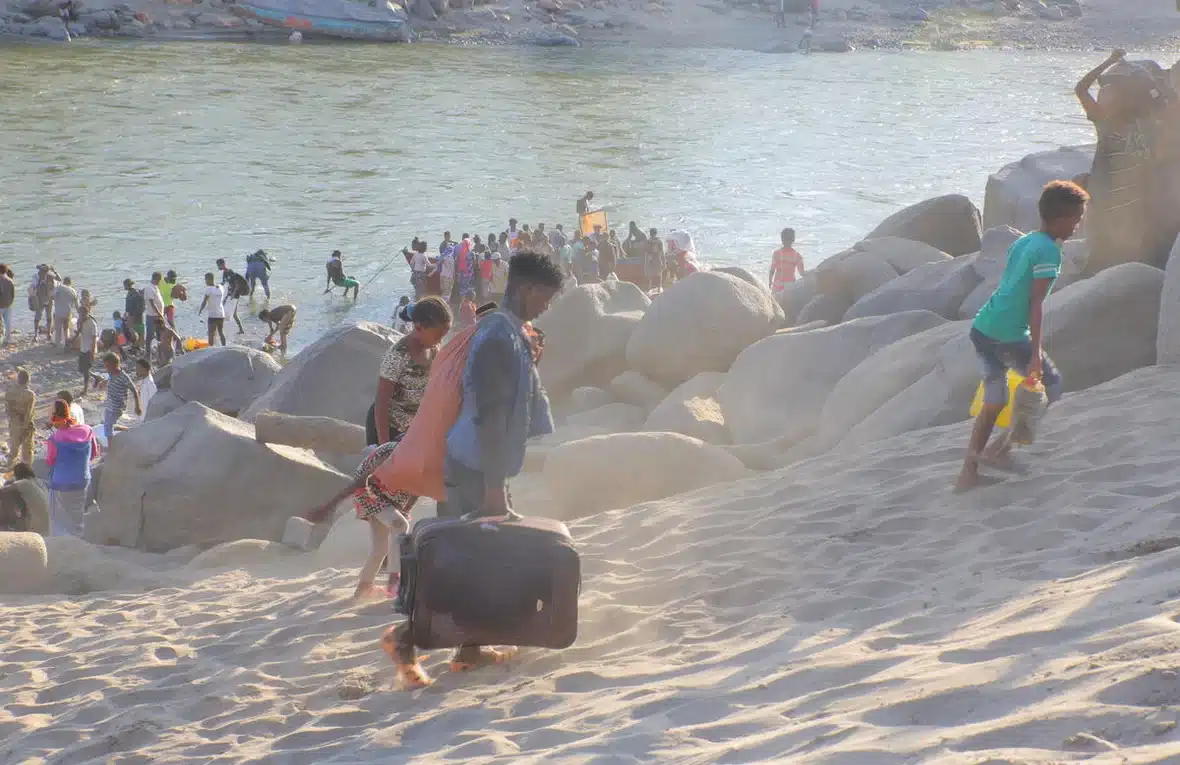
Refugees fleeing violence in Ethiopia’s Tigray region cross the Tekeze River into Sudan in November 2020. © UNHCR/Hazim Elhag
This is a summary of what was said by Elizabeth Tan, UNHCR’s Director of International Protection and Solutions – to whom quoted text may be attributed – at today’s press briefing at the Palais des Nations in Geneva.
GENEVA – Seventy-five years after the Refugee Convention was opened for signature on 28 July 1951, it remains the foundation of the international refugee protection system and one of the most consequential international legal instruments ever adopted.
Born in the aftermath of the Second World War, it codified a simple but powerful principle: people forced to flee persecution, conflict or violence must be able to find safety and protection.
No society is immune to war, persecution or sudden upheaval. The Convention was built on that universal truth: that people forced to flee must be protected.
Over the past seven and a half decades, it has been a lifeline for people fleeing conflicts and persecution, from post-war Europe and wars of national liberation across Africa, to the Indochina wars and military dictatorships in Latin America, to more recent crises in Afghanistan, Syria, Ukraine and Sudan.
A total of 149 States are parties to the Convention, its 1967 Protocol, or both, making it one of the most widely supported international legal frameworks. Together, the Convention and its Protocol define who is a refugee, set out refugees’ rights, and establish the standards of treatment States have agreed to uphold. The core principle of non-refoulement – prohibiting the return of people to a place where they would face persecution, torture or other serious harm – is recognized under customary international law, which applies to all countries, whether or not they have signed the Convention.
Importantly, the Convention has proven to be a living instrument, retaining its relevance in responding to contemporary challenges. Through evolving State practice, court decisions and guidance from UNHCR, the UN Refugee Agency, it has supported protection responses to issues such as gender-based persecution, forced recruitment and risks that may be compounded by climate impacts where these intersect with conflict, persecution or other serious harm.
In a world experiencing record levels of crisis and instability – with more than 130 armed conflicts recorded worldwide in 2025, according to the International Committee of the Red Cross – some 41.6 million refugees remained uprooted. Even amid increasingly polarized debate, public support for asylum remains strong, with around two-thirds of people surveyed this year by Ipsos across 29 countries supporting the right of those fleeing war or persecution to seek refuge.
The global asylum system, however, is under strain. Nearly 70 per cent of refugees are hosted by low- and middle-income countries, many of which face their own economic and development challenges. Seven in ten refugees live in exile for five years or more.
Some argue that the Convention is no longer suited to today’s globalized world of mixed movements and overstretched asylum systems. We disagree. The Convention remains the framework that allows States to distinguish those who need international protection from those who do not, while ensuring that no one is returned to persecution, torture or other serious harm. Fair and efficient procedures to determine refugee status protect refugees, reassure host communities and preserve confidence in asylum. UNHCR is ready to redouble its work with States and partners to ease capacity constraints and ensure decisions are accurate and as swift as possible. Those who do not need refugee protection should not be granted asylum and can be returned, safely and in dignity. That, too, is part of a credible asylum system.
At the same time, border management must remain anchored in protection. We are concerned by practices that restrict access to asylum, including pushbacks, denial of access to territory and forced returns. The Convention provides a framework for States to manage borders while protecting people with a well-defined need for international protection.
These pressures are compounded by severe funding shortfalls. With UNHCR funded at only 31 per cent as of the end of June, essential services for people forced to flee – including extremely vulnerable groups – are being constrained.
Marking the 75th anniversary of the Convention, UNHCR is calling for renewed commitment to the institution of asylum, stronger international cooperation and greater support for refugees and the communities that host them. Through a series of dialogues in 2026 – taking place at local, regional and global levels, and involving governments, civil society, refugees, the private sector and other stakeholders – we are working to identify practical ways to strengthen protection and advance solutions.
Seventy-five years on, the Convention is a test of our collective resolve today to protect those forced to flee and to keep asylum available for those who need it.
For more information, please contact:
- In Geneva, Carlotta Wolf, wolf@unhcr.org, +41 79 546 67 07


