


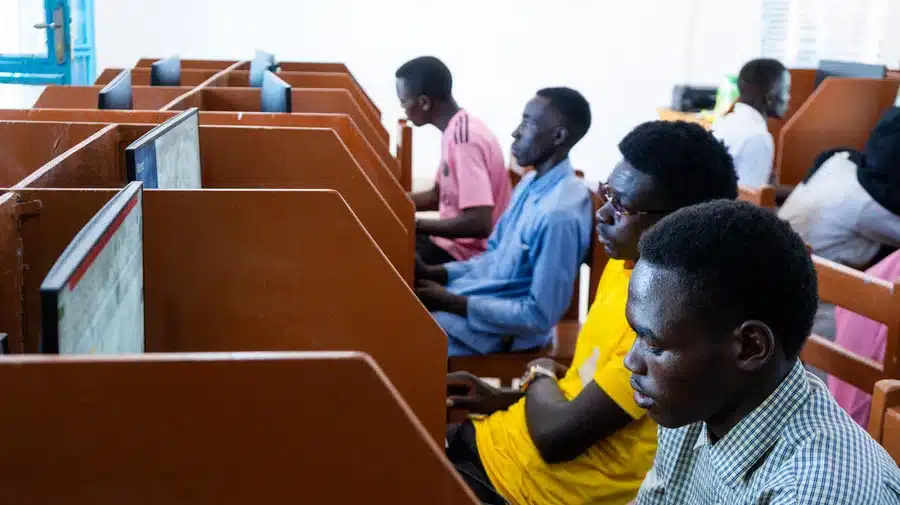
Sudanese refugees using computers at a connectivity centre in Farchana refugee settlement, Chad. © UNHCR/Insa Wawa Diatta
This is a summary of what was said by UNHCR Senior Advisor on Information Integrity Gisella Lomax – to whom quoted text may be attributed – at today’s press briefing at the Palais des Nations in Geneva.
GENEVA – UNHCR, the UN Refugee Agency, is concerned that the spread of misinformation, hate speech and deepfakes is exacerbating and inciting real-world harm to refugees and humanitarians. Artificial Intelligence is intensifying these risks to the integrity of our information ecosystem and undermining trust, but it can also be part of the solution if managed in the right way.
AI is transforming our world and, built with purpose and inclusivity, will bring opportunities and tangible benefits, including for refugees. It can also help address complex information challenges in humanitarian contexts. At the AI for Good Summit in Geneva today, UNHCR convened government, technology and academic experts to discuss positive responses to complex information challenges.
It is critical that humanitarian and refugee perspectives are included in international AI governance efforts. For example, ensuring that content moderation tools work effectively in humanitarian contexts and less-common languages: this means placing people at the heart of trust and safety teams, and creating clear frameworks on guardrails and manipulation.
This important work is happening against a backdrop of increasing information challenges. From Africa to Asia-Pacific, the world’s largest displacement crises are often also information crises.
When information is distorted, it can reduce access to jobs and education, make integration harder and threaten social cohesion. Online rumours, false accusations, scapegoating and dehumanizing speech have triggered protests and attacks. In extreme cases, they have been linked to physical violence, killings, and are even a factor in forced displacement. Just last month, UNHCR’s digital communications for the International Day to Counter Hate Speech were deluged with hateful comments.
The spiral of mis- and disinformation poses risks to humanitarian operations and security. UNHCR has noted an increase in false, hostile narratives targeting operations and staff, which have the potential to significantly impact fundraising at a time of shrinking budgets and growing needs.
A recent UNHCR survey found that 93 per cent of staff respondents had witnessed misinformation, disinformation or hate speech, affecting delivery of our mandate. Women – among both refugees and staff – are being disproportionately targeted. Generative AI compounds the effects, at scale. For example, harmful AI-generated deepfake videos of UNHCR staff and refugees are a growing challenge.
Refugees, already reeling from trauma, are being limited or prevented from accessing protection services like registration, as well as life-saving assistance and other services. This can cause huge risks and even death, as we have seen recently in Libya, where a wave of violent hate speech and dangerous misinformation incited hostility and abuse of refugees, and affected the safety of UNHCR staff and humanitarian workers supporting the displaced and host communities. Serious examples include deepfakes of the UNHCR Representative, online calls to share the GPS coordinates of staff addresses, and videos describing national staff as traitors to their country.
Hate speech knows no borders and spreads rapidly. Communities that have been forced to flee their homes by persecution and violence, such as the Rohingya, continue to face dehumanizing narratives online, even in exile. Online hate fuels real-world harassment and intimidation, eroding social cohesion and deepening divisions between host communities and displaced populations.
UNHCR fully believes that freedom of expression is fundamental, and everybody, including refugees, should have access to receive and impart ideas and information. This isn’t about how legitimate societal concerns on migration and asylum are debated online, but about life-threatening information risks that can lead to serious harm in humanitarian contexts. For example, bad actors, including smugglers and traffickers, can exploit digital platforms with disinformation to deceive people forced to flee with false promises of safety, legal pathways, and employment, leading them into dangerous and exploitative situations.
UNHCR’s response is practical and collaborative. Thanks to Switzerland, we created a Community of Practice on Information Integrity in Humanitarian Contexts. We partner with different stakeholder groups at local and global levels. Initiatives such as the Global Refugee Forum Multistakeholder Pledge on Information Integrity, launched with Google in 2023, can inspire further multilateral approaches. Encouraging progress is happening, but it needs to be systematized.
Refugees are at the heart of this work. Local partnerships helped shape UNHCR’s Information Integrity Response Toolkit. Used by 2,000 practitioners to guide practical action, from risk assessments to community-based responses, it is one visible example of our collaborative approach.
The challenge is fast-evolving and cannot be solved by any one actor alone. It is essential that refugee and humanitarian contexts are not left behind in discussions about AI governance. Trusted information is a necessity for refugee protection, and information integrity helps save lives and maintain trust.
For more information, please contact:
- In Geneva, Matthew Saltmarsh: saltmars@unhcr.org, +41 79 967 99 36


