


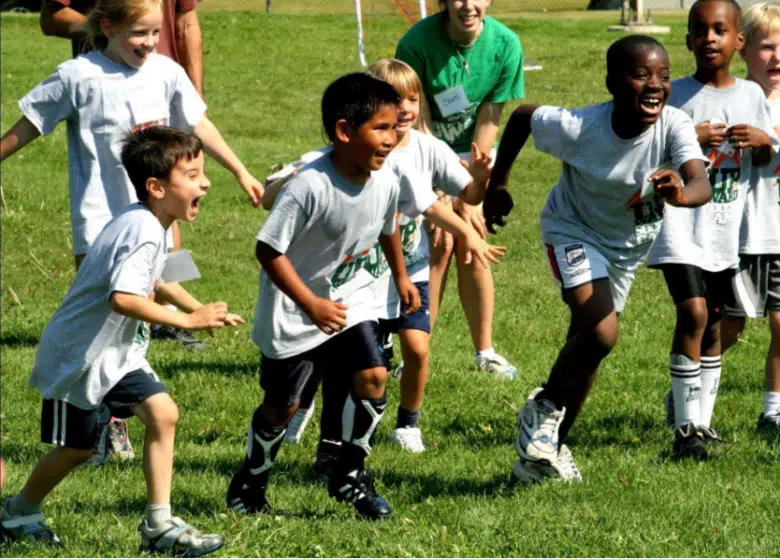
Children running in one of Umoja’s soccer programs. Photo Credit: Umoja.
By Erika Ehrenberg in Ottawa, Canada
In the southwestern Calgary community of Glenbrook, children as young as five set up orange, plastic cones to mark their field. In a small park—modest and once underused—young children soon arrive.
Around the neighborhood, youth leaders called Community Captains call their friends to make sure that they will be coming to soccer that day. A bus driven by Salih Ali, who also happens to be the former captain of the Eritrean national soccer team, picks up talented young players and brings them to their games. Ali is also a coach, mentor, and role model, supporting young coaches and strengthening his community.
Through all these different pieces – from setting up the field to organizing friends to play – youth are learning important values: honesty, respect, reliability, and hard work. At the same time, a community rooted in inclusion and contribution is being built.
This is the vision of Jean Claude Munyezamu and his organization, Umoja Community Mosaic.
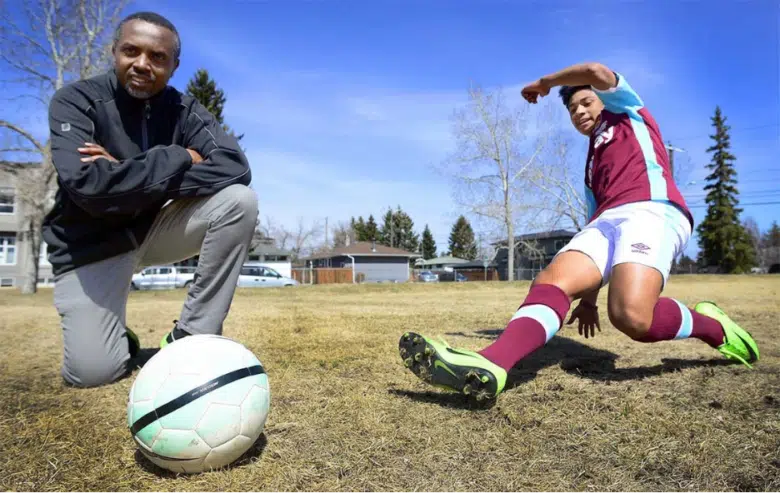
Jean Claude Munyezamu (left) kneels behind a soccer ball with Moneer Mehalhel sliding towards the ball (right). Photo Credit: Umoja.
Fifteen years ago, Jean Claude recognized that in his public housing community, integrating vulnerable youth—often newcomers and refugees—into the community was not enough, nor was the simple goal of keeping them out of trouble. What was missing was an opportunity for these youth to feel a sense of belonging and a pathway to contribute.
Fortunately, Jean Claude knew firsthand the power of soccer to bring people together and create belonging.
When he was a child living in Kigali, Rwanda, he learned how to make soccer balls out of plastic bags. “The soccer ball made me belong, created friends for me,” he recalls. When he left Rwanda as a refugee in 1993, he eventually arrived at Kakuma refugee camp in Kenya. Though it was frightening to be in a camp where almost nobody spoke his language and communication felt impossible, he saw an opportunity amidst adversity.
“Plastics were everywhere—wrapping from aid deliveries—and it reminded me of my own childhood in Kigali, making soccer balls from plastic bags. I started making balls, and kids soon gathered around. We didn’t need words; we all understood soccer.”
“I did not speak their language, they did not speak my language, but we came to understand one another. I felt this is how i created the belonging… I could not speak, but I felt I could be understood... We didn’t need words; we all understood soccer.”
– Jean Claude Munyezamu
Jean Claude came to Canada in February 1998, first arriving in Montreal and settling in Calgary two months later. “I never [thought] I would go to Canada. Canada happened to be the country that adopted me,” he recalls. “The country accepted me… it’s my choice to contribute and belong.”
In his neighborhood of Glenbrook, he saw the parallels between life in the refugee camps and public housing—communities with strength and potential yet often disrupted by exclusion and lack of opportunities.
Jean Claude started ‘Saturday Soccer’, a grassroots soccer program for local youth in Calgary, which formalized into ‘Soccer Without Boundaries’ in 2009. The program began in a small park in Glenbrook, where children learned not only how to play, but how to take responsibility by setting up their own field. “The goal is to catch them before they fall,” he explains, “we always move with them and try to meet them where they are.”
Over a decade, cultivated by Jean Claude’s lead-by-example approach and dedication to mentorship, partnerships with schools and community associations grew, and children were connected to competitive clubs. In 2020, Soccer Without Boundaries expanded to be part of a larger community organization and neighborhood movement called Umoja Community Mosaic.
Today, Soccer Without Boundaries continues as the flagship program under the broader organization of Umoja. It boasts 800 participants and 85 volunteers from 52 countries, and is largely run by former participants, people who understand the journey firsthand. In addition to recreational soccer, competitive soccer, adult U23 and men’s teams, Soccer Without Boundaries offers leadership development rooted in service for players within its network.
“We invest in them, then they come back as mentors,” Jean Claude proudly explains. “Almost 100% of our coaches are the kids who grew up in the program… The kids who join us never go.”
Nearly all camp staff—about 85 young people—came through the program themselves. He describes Soccer Without Boundaries as a movement, where players come to participate, volunteer, and for many, get hired in their first job as coaches. Jean Claude believes in empowering the youth who are closest to their own social issues, because success happens when “the people who are closest to the problem are the ones who are tasked to solve it.”
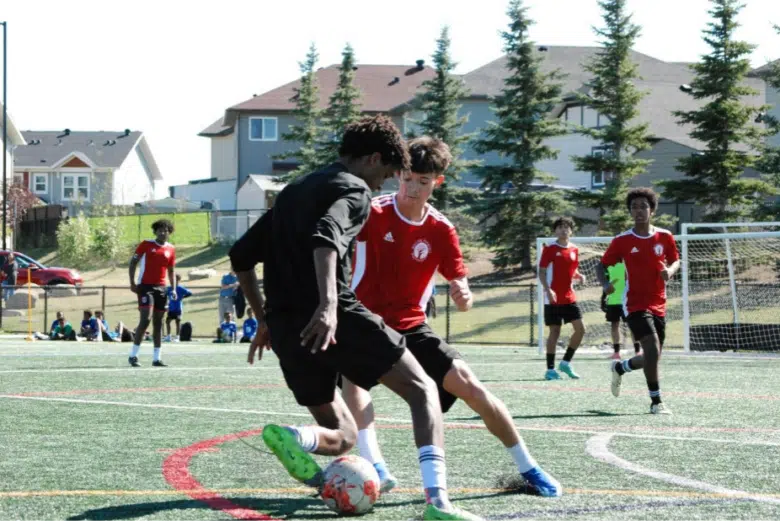
Two teams playing against each other during Umoja’s soccer tournament which takes place at the end of the summer soccer camps. Photo Credit: Umoja.
“The goal was not mining talent, it was creating belonging,” says Jean Claude, as he shares that competitive players from Soccer Without Boundaries have been invited to try out with professional clubs, including Premier League teams such as West Ham United.
Yet success is measured differently at Umoja. “If you cannot play, we find a way you can contribute,” he says. “It’s very, very inclusive. Come and play, and if you’re not good at playing I am going to find something you are good at.”
Whether it is in the recreational program or the competitive stream, Jean Claude ensures that there is a space for everyone in soccer.
“The goal was not mining talent, it was creating belonging.”
– Jean Claude Munyezamu
For refugee youth in particular, Soccer Without Boundaries presents an opportunity to build their social and language skills.
“Some kids arrive without speaking any English,” Jean Claude explains. “Finding a way to mix [refugee youth] with other children has been very beneficial. Soccer becomes the common language.”
With children from over 30 different countries on the same field, the game becomes the shared means of communication. Through the game, youth build friendship, confidence, leadership, and conflict-resolution skills.
His philosophy is simple: “My goal is for this kid to come back tomorrow.” He teaches teamwork through analogy—”There is a Ronaldo, there is a Messi and there’s everyone else. They train together but they have different skills.” And when the soccer game gets rough, he reminds players, “We [are] Umoja. We’re gonna stay on our values. Continue to be who you are.”
Jean Claude’s vision extends beyond Calgary. In recent years, he has travelled internationally to support small, community-led initiatives—bringing water to schools, providing jersey and soccer balls, and encouraging youth-led soccer programs. He hopes that the culture he has created at Soccer Without Boundaries and Umoja empowers others around the world to start something themselves.
“I tell refugees everywhere, you have something to contribute to your community. I started with a soccer ball in a neighbourhood to solve one simple problem that was in the community, then it snowballed. Whatever you can contribute, that’s how you’re going to belong.”
With the FIFA World Cup set to be played in part in Canada, Jean Claude sees a moment of deep significance.
“The World Cup coming to Canada is so much more than a sporting event,” he says. “In much of the world, soccer is culture. Hosting the World Cup will create lasting opportunities for young people and communities, and it’s a huge point of pride for Canada.”
For the youth at Umoja, he adds “it’s a celebration of belonging. They will watch their heroes right here, in their own country. That’s something I never could have imagined as a child in Kigali—or in a refugee camp. It tells them, you belong here.”


