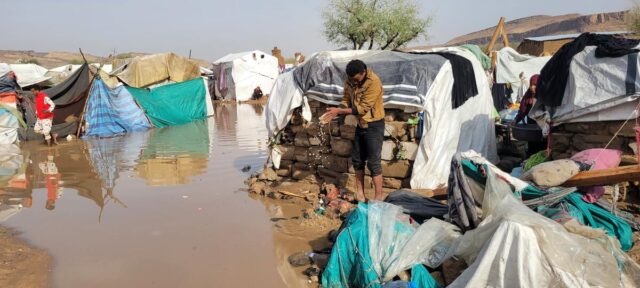


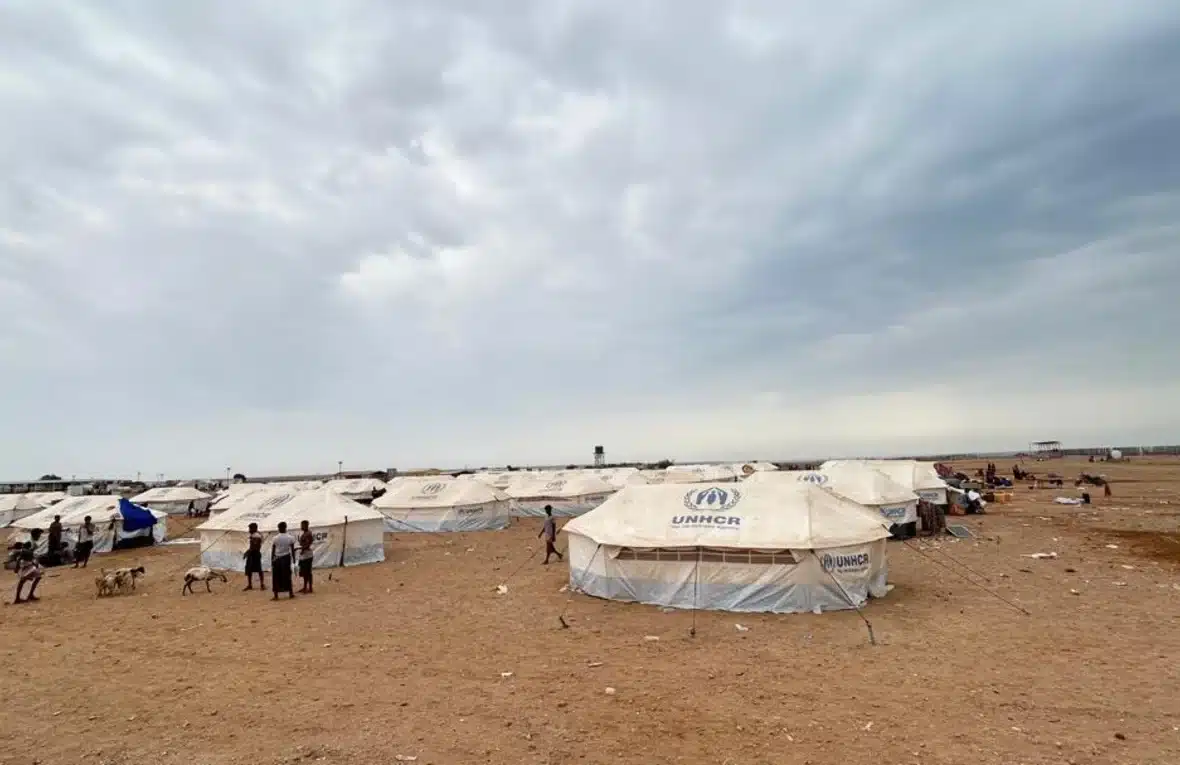
Newly arrived families fleeing Yemen are hosted in refugee sites near Obock, Djibouti. © UNHCR
This is a summary of what was said by Sandrine Desamours, UNHCR Representative in Djibouti – to whom quoted text may be attributed – at today’s press briefing at the Palais des Nations in Geneva.
DJIBOUTI – Nearly 3,000 people have arrived in Djibouti in less than a week, making the dangerous sea crossing across the Bab el-Mandeb Strait, as escalating violence forces more families to flee Yemen.
Refugees continue to arrive by boat through Obock, Khor Angar, Moulhoule and Godoria after difficult journeys in small vessels. Some describe having to leave family members behind, and reports indicate that thousands more trying to leave Yemen have been unable to flee due to insecurity and shortages of fuel for boats, leaving them stranded.
At reception centres in Djibouti, new arrivals recount fearing for their lives in Yemen having fled sudden bombardment, shelling and gunfire. Mothers quickly gathered their children and whatever they could carry before heading to the coast and boarding small boats. More than half of the Yemeni refugees crossing to Djibouti are women and children.
Many are now facing displacement for a second time, having fled Yemen during the 2015 crisis and returning when they felt safe, only to find themselves refugees once again.
In Obock, new arrivals are being transferred from coastal entry points to Markazi refugee village, where they can be registered, receive support and access national services. UNHCR and partners have been working to integrate the new refugee children into the village’s schools. Djiboutian families and the Yemeni refugee community itself have continued to welcome new arrivals, sharing what little they have. Around 270 people are currently living with host families.
However, capacity is rapidly diminishing. Markazi refugee village was designed to host 5,000 refugees; there were already over 2,700 Yemeni refugees and 1,500 Eritrean refugees living there. While the Government, UNHCR and partners are preparing for at least 10,000 new arrivals, pressure is already growing on shelter, water, sanitation, health care and education. Existing school facilities cannot accommodate all newly arrived children, while overcrowding could increase the risk of communicable diseases, including scabies and diarrhoeal disease.
UNHCR and partners are on the ground providing temporary shelter, transportation, relief items, food, water and health care, while supporting the Government of Djibouti and the national refugee authority with reception, registration and protection activities.
Djibouti already hosts some 36,000 refugees, mainly from Somalia and Ethiopia, and the latest arrivals from Yemen are placing further pressure on an already stretched response.
Authorities in Somaliland and Puntland have also reported increased arrivals from Yemen, including Yemeni refugees and Somali refugee returnees. Numbers remain in the hundreds for now, with movements currently constrained by El Niño-related sea conditions. However, maritime movements are expected to ease from mid-October, raising the possibility of further arrivals if insecurity in Yemen persists. UNHCR and partners are therefore closely monitoring the situation and preparing for a potential increase in movements across the Gulf of Aden.
Meanwhile, the crisis inside Yemen is becoming more acute; more than 100,000 people have already been uprooted as fighting intensifies, particularly along the western coast. Families have been displaced across Al Hodeidah, Ta’iz, Lahj, Aden, Abyan, Marib, Al Dhaleh and Shabwah, while insecurity and access constraints are making it increasingly difficult for humanitarian partners to reach people in need. Without improved access and additional support, further displacement within Yemen and across borders is increasingly likely.
To date, UNHCR’s Djibouti operation is only 15 per cent funded, and UNHCR urgently requires an estimated $5.1 million to ensure that refugees arriving from Yemen can access registration, reception, protection and essential services. Our operations inside Yemen are just 18 per cent funded, and an additional $14 million is urgently needed to provide shelter, relief items and site management support to newly displaced families.
UNHCR is calling for urgent international support to respond to the rapidly growing needs of people forced to flee inside Yemen and to Djibouti. Without additional resources now, already stretched protection and assistance risk being overwhelmed as displacement continues to rise.
For more information, please contact:
- In Nairobi (regional), Dana Hughes, hughes@unhcr.org, +254 717 540 160
- In Amman, Rula Amin, aminr@unhcr.org, +962 790 045 84
- In Geneva, Eujin Byun, byun@unhcr.org, +41 79 747 8719