

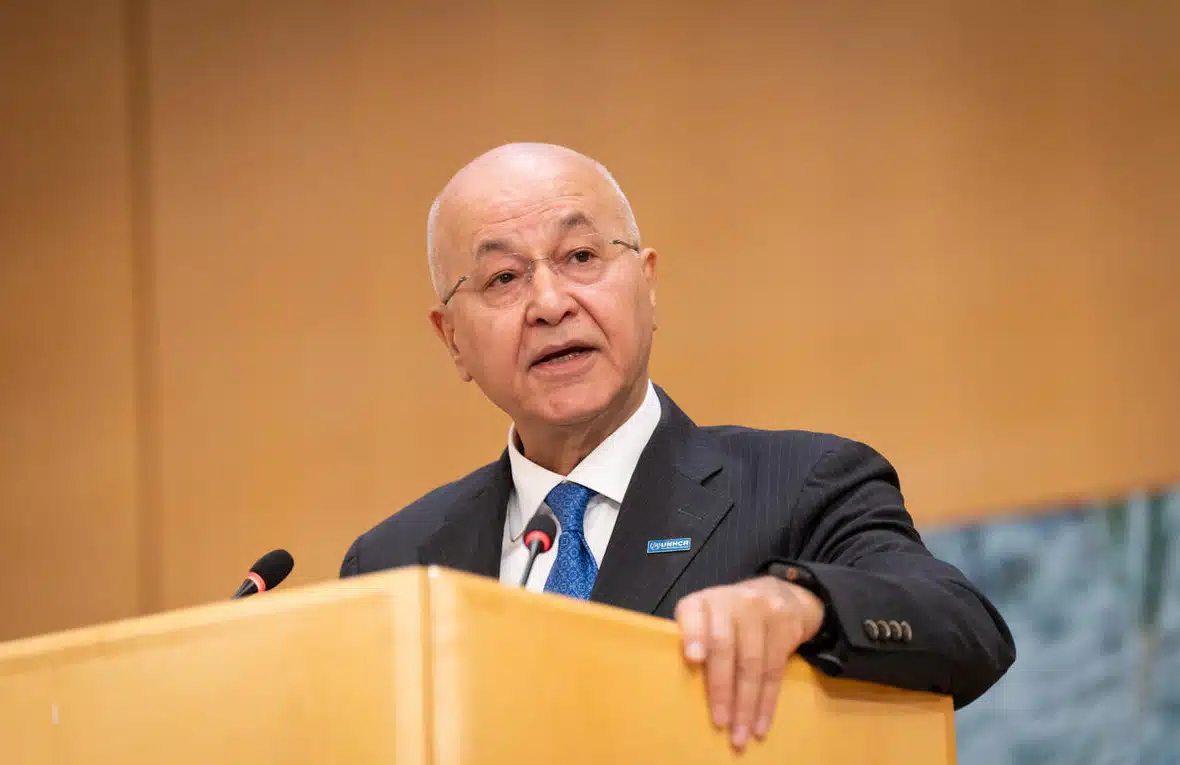
UN High Commissioner for Refugees Barham Salih delivers his opening speech at the 77th Executive Committee meeting in Geneva. © UNHCR/Anne-Laure Lechat
As delivered
Mr. Chairman, distinguished delegates, colleagues, partners and friends,
It is my great honour to address the Executive Committee for the first time as High Commissioner for Refugees.
Before I begin, allow me to express my deepest solidarity with the people of Panama following the powerful earthquake that struck the country last week. Our thoughts are with all those who have suffered loss, injury, and displacement as a result of that tragedy. We commend the efforts of the Panamanian authorities, local communities, and humanitarian partners responding under very difficult circumstances.
Excellencies,
Nine months into this role, I am conscious of the history of this Office, the trust placed in it, and above all, the people at the heart of our mandate: those forced to leave their homes and communities.
I come to this responsibility with a deeply personal perspective.
I know what it means to need protection. And I know the difficult decisions governments must take. And I understand how profoundly those decisions can shape people’s lives.
The pressures are real. So are our responsibilities.
These nine months have also shown me the scale of our challenge. Conflicts are becoming more protracted. Displacement lasts longer. Resources are shrinking.
New emergencies demand immediate action, while millions of people displaced by older crises are still waiting to rebuild their lives.
This is a difficult moment for UNHCR. But it is also a reminder of why UNHCR remains relevant, vital and indispensable.
Seventy-five years after the adoption of the Refugee Convention, the responsibility at the heart of our mandate remains as urgent as ever.
People forced to flee need protection. Countries and communities receiving them need support.
And refugees need more than survival.
They need to recover control over their lives and, ultimately, find a solution to their displacement.
In the last nine months, I have visited 15 UNHCR operations, from Chad to Ukraine, Ethiopia to Afghanistan, Syria to the Sahel, Mexico to Venezuela.
I have listened —to displaced people, host communities, governments, and colleagues.
I have met people arriving across borders with almost nothing. I have met refugees who have lived in exile for decades. I have met people making the difficult journey home, determined to begin again.
What I have seen has reinforced one conviction:
We must protect people when they are forced to flee. But we cannot accept indefinite displacement as their future.
Humanitarian assistance saves lives and remains indispensable wherever people need it. But another year of survival in displacement cannot, by itself, be our measure of success.
Success must also mean people recovering agency: being able to work, to learn, to support their families, and to make the choices about their future.
We must measure success not only by the lives we save, but by the lives people are able to rebuild, and the lasting solutions they can find.
Mr. Chairman, as you mentioned, more than 117 million people have been forced to flee their homes by conflict, violence, persecution and other threats.
Behind that figure are painful, tragic human realities.
In Sudan, the conflict has displaced millions. On my first mission as High Commissioner, at the border between Sudan and Chad, I met families who had fled the violence in Darfur days earlier. Some had lost parents. Others were separated from their children. Crossing that border meant the difference between life and death.
In Ukraine, millions remain displaced while the war continues to destroy homes, infrastructure and lives. I witnessed the devastating human toll firsthand during my first visit in February.
Across the Sahel, violence and insecurity uproot communities and strain States already confronting poverty and climate shocks.
And more than nine years after the mass displacement of 2017, over 1.2 million stateless Rohingya refugees remain in Bangladesh, unable to return safely to Myanmar.
For more than half a century, generations of Sahrawi refugees have lived in camps near Tindouf, where our work continues, but where humanitarian conditions are increasingly challenging.
In Yemen, the recent escalation has already displaced hundreds of thousands, compounding the immense suffering of millions from years of conflict. Saturday’s and last night’s deplorable attack on the airport in Riyadh killed 12 people and injured more than 300. This dangerous escalation must end – and every effort must be made to bring this conflict to an end.
Across Latin America, violence, insecurity and political instability has led to uprooting communities. The region hosts more than 22 million forcibly displaced people, with 10 million people internally displaced across the region, including more than 7 million in Colombia and 1.4 million in Haiti.
These crises are profoundly different. But they reveal the same pattern.
Conflicts are producing displacement faster than we are resolving it.
Humanitarian organizations are left to manage the consequences.
We will continue to protect people, support host communities, and use humanitarian diplomacy to secure access and advance solutions.
But humanitarian assistance cannot indefinitely compensate for unresolved wars. Ending them requires political leadership.
We need greater investment in conflict prevention, diplomacy, peacebuilding and development. When openings emerge, they must bring real change: sustained safety, voluntary returns when conditions permit, and the chance to rebuild lives.
Peace must be measured not only by agreements signed, but by the lives changed.
Until then – sadly, painfully – people will continue to flee.
And when they do, our responsibility is clear: they must be able to find protection.
Excellencies, Mr. Chairman,
This year marks the 75th anniversary of the 1951 Refugee Convention.
Seventy-five years ago, in the aftermath of the Second World War, States made a promise: people fleeing persecution must be able to seek protection, and refugees must not be returned to places where their lives or freedom are threatened.
The Convention was not born because protection of refugees was easy. It was born because the world had seen the cost of failing to protect them.
That promise has saved generations of lives. Today, it remains as vital as ever – but it is being tested as never before.
In discussions with States, refugees and civil society across regions, I have heard the concerns of States whose asylum systems are under pressure; the frustration of countries hosting refugees for decades without adequate support; and the challenges of mixed movements, dangerous journeys and the exploitation of people by smugglers and traffickers.
I have also heard the fears of refugees themselves as protection space contracts, humanitarian assistance becomes scarcer, and uncertainty grows; women and girls exposed to violence and exploitation; children losing years of education; and persons with disabilities facing barriers to protection, services and opportunities.
These concerns, Excellencies, colleagues, are real. We should confront them honestly.
We need fair and efficient asylum systems, stronger support for host countries, cooperation along the routes, and more regular pathways.
We should also ensure dignified return for those found not to need international protection following fair procedures, and appropriate safeguards.
We must safeguard the asylum system against abuse while ensuring access to protection and upholding non-refoulement.
None of this requires retreating from the Convention.
It requires implementing it better.
Perhaps that is the most important message of this 75th anniversary:
The principles endure. Our collective efforts to implement them must evolve.
We have adapted before: the 1967 Protocol removed the Convention’s temporal limitations and, for States parties to the Protocol, generally its geographical limitation. When the world changed, States chose to extend protection, not abandon it.
Sixty-five years after the 1961 Convention on the Reduction of Statelessness, millions still lack a nationality.
Together with the 1954 Convention protecting stateless persons, these instruments give States tools to reform discriminatory laws and prevent childhood statelessness.
With political will, people can belong somewhere in law as well as in life.
We do not walk away from a promise because keeping it has become difficult. That is when the promise matters most.
Protection is indispensable. But our responsibility does not end with safety. It must also include lasting solutions.
For 75 years, Mr. Chairman, UNHCR’s mandate has rested on three responsibilities: international protection, life-saving humanitarian assistance, and solutions.
All remain indispensable. We must pursue them together from the outset.
In 2026, UNHCR has responded to 22 emergency declarations across 18 countries, including 17 newly declared emergencies in 15 countries. From Yemen to the East and Horn of Africa, Sudan to the Sahel, including Niger, our emergency capacity remains essential.
When people are forced to flee, we must be there: protecting them, providing essential assistance, and supporting the countries and communities receiving them.
But we must ask ourselves an equally important question: What happens after the emergency?
Too often, what begins as temporary becomes permanent.
A refugee settlement established in an emergency remains decades later. A child born there becomes an adult, raising children of their own. Programmes designed for survival become permanent systems of dependency.
We must work towards a future where one generation of refugees is not forced to pass its displacement to the next.
This is the ambition behind 50by35.
By 2035, our vision is to reduce by half the number of refugees in long-term displacement who remain dependent on humanitarian assistance, through greater self-reliance and lasting solutions. Today, approximately 14.5 million refugees in such situations in low- and middle-income countries depend on aid for their basic needs.
It is an ambitious goal. It needs to be.
But let me be clear: 50by35 is not a target to reduce humanitarian assistance. It is a commitment to reduce the need for it.
We cannot claim success because assistance has been reduced. Or that the responsibility has been shifted to hosting states. Success must be measured by whether people’s lives have actually improved, and they have become self-sufficient, contributing members of their communities. For those who continue to need humanitarian support, our responsibility remains.
That starts with protection and good policies: legal status, documentation, freedom of movement, education, and the right to work.
Governments are already showing what is possible.
In Ethiopia, more than 30,000 work permits and authorizations have been issued to refugees, over 123,000 hold national digital identification, and refugee schools are being progressively integrated into the national system.
In Thailand, refugees from Myanmar who spent decades in temporary shelters are gaining access to employment, documentation, banking and services.
Uganda continues to promote economic inclusion, while Kenya’s Shirika Plan is advancing integration into national systems and local economies.
In Mexico, more than 175,000 refugees and asylum-seekers have benefited from the Local Integration Program, under which refugees have found formal employment with more than 650 companies. Building on this experience, UNHCR is working with the Government of Mexico on México Integra, to establish a comprehensive, nationally owned, State-led integration system.
These are changes in government policy that give people greater control over their futures and reduce dependence on humanitarian assistance.
But self-reliance and inclusion are not the same as a durable solution.
We must also accelerate and facilitate voluntary return where conditions permit, resettlement and complementary pathways, and local integration or alternative legal status.
For many refugees I have met, going home remains their deepest hope. That hope deserves our support.
Crossing a border, however, is not, by itself, a solution.
Without documentation, livelihoods, schools, functioning services and security, return may not be sustainable.
I have seen this in Syria, where some 1.8 million refugees from neighbouring countries and more than 2 million internally displaced people have returned to their areas of origin since December 2024. I saw the destruction left by years of conflict, but also the determination to rebuild.
In Afghanistan, nearly 7 million people have returned from neighbouring countries since late 2023, often under difficult circumstances and not always voluntarily. Communities are struggling with poverty, limited services, and notably restrictions placed on women and girls. UNHCR, UNDP and other partners are supporting reintegration, but the scale demands much greater international investment and support.
In Venezuela, I met Andriuska, who returned from Ecuador with her family. Her determination reflects the hopes of many Venezuelans who wish to return and contribute to their country’s future. There are important opportunities to support such voluntary returns, and they must be pursued.
In the Central African Republic, government leadership and regional cooperation are opening opportunities for thousands of refugees to move towards solutions, to return home.
In the Great Lakes region, renewed cooperation between Rwanda and the Democratic Republic of the Congo is creating opportunities to address long-standing displacement. More than 70,000 Congolese refugees have returned to the DRC in 2026, while thousands of Rwandans have returned to Rwanda. Through the tripartite mechanism, UNHCR supports voluntary return and sustainable reintegration.
These are important opportunities, but return depends on sustained international support. Countries receiving large numbers of returnees need investment in security, housing, services and livelihoods so that people can rebuild their lives and remain home.
Equally, hosting states – Lebanon, Jordan, Egypt – which host some of the world’s largest refugee populations per capita while facing extensive internal displacement and conflict-related damage, in the case of Lebanon, also need continued support to extend protection beyond sustainable returns.
Return is an event. A solution is what comes after.
Resettlement remains indispensable for refugees whose protection needs cannot be met where they are. Complementary pathways through employment, education, family reunification, and community sponsorship to help refugees find safety and rebuild their lives are also critical.
We need countries with established resettlement and complementary pathways to expand these opportunities.
50by35 is now moving from vision to implementation.
We are changing, Excellencies, how we plan and deliver programmes in protracted situations. Country by country, we are aligning our programmes with government-led priorities for self-reliance and solutions, engaging development partners earlier.
We will soon launch a Global Strategy for Self-Reliance to expand refugees’ access to employment, finance, entrepreneurship and markets. UNHCR’s role is to act as a catalyst, helping partners to connect refugees to markets and value chains, including through policy reforms and area-based investments.
We are deepening our engagement with the World Bank, the International Finance Corporation, the International Monetary Fund and other regional development banks to bring displacement more systematically into development and economic planning and mobilize development financing and investment for refugees and host communities.
We will also launch the 50by35 Accelerator, a dedicated financing window within UNHCR that will provide flexible, multi-year resources additional to our existing budget to accelerate opportunities for inclusion, self-reliance, and solutions. The Accelerator will support targeted interventions and technical assistance to mobilize larger government-led and development investments.
I am grateful to donors like Denmark, Germany, the Netherlands, and the United Kingdom for their continued investment and thought leadership in self-reliance work. The EU and the Mastercard Foundation are both front-runners in supporting the initiative. The Accelerator will build upon these efforts and help take them to scale.
Through the Joint Data Center on Forced Displacement with the World Bank, we are strengthening how we measure refugee self-reliance, protection and solutions, drawing on national statistical systems wherever possible to track progress and assess impact.
From the outset of an emergency, we should ask not only how we protect and assist people today, but how we will enable them to rebuild their lives tomorrow.
The shift is from managing displacement indefinitely to changing the conditions that keep people displaced and dependent.
Mr. Chairman, Excellencies,
None of this can be achieved by UNHCR alone.
It begins with the leadership of refugee-hosting countries. But it cannot succeed by asking those countries to do more with less.
Inclusion cannot be financed by goodwill alone.
Schools need teachers. Health systems need capacity. Municipalities need infrastructure. Economic inclusion requires investment and jobs.
This matters particularly because most refugees continue to be hosted by countries with considerably fewer resources. Countries representing just 27 per cent of global wealth host 80 per cent of the world’s refugees.
I want to recognize those countries today.
Many have kept their societies and their countries hospitable, accommodating refugees through successive crises. They have included refugees in schools and hospitals already under pressure. They have provided land, documentation, and access to work.
Their leadership must be matched by international support.
Achieving this ambition will require sustained cooperation across governments, development institutions and the private sector.
Local communities, civil society, and refugee-led organizations are equally important to this effort. Their knowledge, relationships and leadership are essential to effective responses, and we must support them through more equitable partnerships and sustained investment in local capacity.
Meaningful participation is not measured by how many refugees are in the room, but also by how they can influence what happens in it.
Refugees themselves are already doing much of the work of supporting their families. Across nine major refugee-hosting countries, refugees meet between 60 and 90 per cent of their household needs through their own income, often despite significant restrictions on their ability to work and participate fully in the economy.
Education is equally central.
Today, ladies and gentlemen, 5.8 million refugee children remain out of school. While access to higher education has increased significantly, the gap between refugee students and their peers remains profound.
Education is both protection and agency.
A young refugee able to study, develop skills, and enter labour markets has a fundamentally different prospect from one who spends years excluded from opportunity.
For girls in particular, remaining in education can also reduce exposure to early marriage, abuse, and other protection risks.
That is precisely why we are planning to launch the Aiming Higher initiative – to give refugee students expanded opportunities to pursue university degrees and other higher education qualifications.
Through this initiative, we are bringing together governments, universities, the private sector, and refugee students themselves to expand access to tertiary education.
We are building on DAFI scholarships, connected learning and third-country education pathways to give more refugee students the opportunity to fulfil their potential.
The Global Compact on Refugees gives us the framework for responsibility-sharing. The Global Refugee Forum gives us the mechanism to translate that responsibility into commitments and action.
Many host nations have already made ambitious commitments: opening national systems, expanding rights and opportunities, and developing nationally led plans for inclusion and solutions.
But international support has not always matched their ambition.
The 2025 Progress Review showed a persistent gap between commitments made by host countries and the financial, material, and technical support provided by the international community.
The next Global Refugee Forum in 2027 gives us an important opportunity to close that gap.
Between now and then, our emphasis must move from pledging to delivery: implementing commitments already made, matching ambitious host-country policies with concrete support.
Mr. Chairman,
We are asking more of the refugee response at precisely the moment when fewer resources are available to sustain it.
As of 9 October, we have funds available of $3 billion, representing 35 per cent of our requirements of $8.5 billion needed for 2026. Our current forecast for 2027 stands at approximately $2.68 billion. This forecast, we hope, will evolve as additional donor commitments become clear, notably at the UNHCR Pledging Conference in December.
We have reduced costs, tightened financial controls, prioritized activities, reduced our footprint and undertaken one of the most significant workforce adjustments in UNHCR’s history.
We have a responsibility to make every resource entrusted to us count.
But efficiency has limits.
There comes a point when greater efficiency cannot compensate for fewer resources.
When funding falls below that point, the consequences are not abstract. They are borne by people who depend on protection.
UNHCR, national and international NGOs, and refugee-led organizations are asked to sustain, and often expand their responses while funding shrinks and becomes less predictable. Some are fighting for their own survival.
I recognize the budget pressures governments face, and our responsibility to use every dime wisely. But there is, again, a difference between doing more with less and being asked to do the impossible.
We cannot ask organizations struggling to survive to keep millions of others alive.
In Sudan, insufficient funding threatens specialized medical care, legal assistance and psychosocial support for more than 50,000 survivors of conflict-related sexual violence.
In Chad, services for thousands of unaccompanied and separated children and children with specific protection needs are at risk.
In Ethiopia, registration has been halted for tens of thousands of refugees from South Sudan and Eritrea, with hundreds of thousands more awaiting verification and integration into the national identification system.
Protection has a floor. Below it, the system does not simply become smaller. The protection we can provide begins to fail.
I am deeply grateful to the governments, institutions, private donors and individuals who have continued to support UNHCR during an exceptionally difficult year. I want particularly to recognize the European Union, Japan and the Netherlands, which have increased their contributions this year, and Sweden, Norway, the Netherlands, Denmark and Germany, which are not only among our top 10 donors, but also make an effort to deliver a high proportion of flexible funding.
I also want to pay special tribute to the private sector and to the individual people across the world whose generosity and commitment to refugees and to our work has remained steadfast and – frankly – extraordinary. Together, they have today become UNHCR’s largest source of income, and largest source of unearmarked funding.
Since I took Office, I have been working with our teams to ensure we have the broadest base of support possible for our work. To be clear: we need a broader base of support. We need funding earlier and more predictably. And we need as much flexibility as your systems allow.
The answer to shrinking humanitarian resources cannot simply be to shrink our ambition in working with and for refugees and solutions.
Excellencies, Mr Chairman,
This has already been a period of profound change for our organization.
Since 2024, nearly 8,000 colleagues have left UNHCR. Our workforce has fallen from nearly 20,000 to just under 12,000.
These are colleagues who have served refugees for years, often in some of the most difficult places in the world, and at considerable personal sacrifice. They leave behind expertise and relationships that cannot simply be replaced. I want to acknowledge them and thank them for their service.
I also want to recognize the colleagues who remain. They have carried this organization through extraordinary uncertainty while continuing to serve refugees, often with smaller teams and greater responsibilities.
Reductions on this scale inevitably have consequences. But despite the contraction, 88 per cent of our workforce remains outside Headquarters, 70 per cent of our staff are locally recruited, and approximately 95 per cent of our protection and solutions capacity remains in field operations. We are determined to preserve these capabilities while ensuring that UNHCR is financially sustainable and aligned with our operational priorities.
But this transformation is about more than numbers.
It is about what UNHCR does, where we do it and how we do it.
Earlier this year, I commissioned an Independent Management Review, undertaken pro bono by Oliver Wyman. Its recommendations, together with extensive consultations across the organization, have informed comprehensive reviews of our country operations, Regional Bureaux and Headquarters.
I have endorsed its broad principles and recommendations. The first decisions are already being reflected in our 2027 planning, budgets and workforce arrangements.
At country level, we have reviewed every UNHCR presence against protection needs, operational risks, and where our direct engagement adds greatest value.
The current proposals would bring changes to 31 presences, approximately one quarter of those reviewed. This will allow us to adopt lighter models where national institutions and partnerships are strong and delivering, while maintaining more direct engagement where protection needs and operational risks are greatest.
The changes are accompanied by appropriate protection safeguards and continued monitoring, with flexibility to strengthen presence should circumstances require it. We have also reviewed Representative grades against the scale of displacement, operational resources, workforce size, and organizational complexity and leadership responsibilities. This will reduce the number of D2 Representative positions from 12 to 6.
At regional level, we are reducing duplication and sharpening the role of the Bureaux. They will become leaner and more strategic, with simpler structures, clearer responsibilities and a stronger focus on oversight and support to country operations.
At Headquarters, we are establishing a leaner and a more focused structure, with clearer accountability for global functions, reduced duplication and stronger alignment of resources with organizational priorities. This involves streamlining senior-level functions and management layers and grades, so that the positions and responsibilities can best support delivery on the organization’s objectives.
The aim is a leaner, less top-heavy Headquarters, with greater authority and responsibility closer to our operations and the people we serve.
We plan to bring our technology and data capabilities, with the use of artificial intelligence, into a more coherent enterprise structure, while keeping Registration and Identity Management anchored in protection and safeguarding the independence of the Data Protection function.
Our Private Sector Partnership model will become lighter and more locally anchored, with greater emphasis on national partnerships, digital fundraising and market development.
We will continue to review and update, in consultation with you, our workforce, financing, and fundraising models to ensure they keep pace with the evolving humanitarian sector environment, needs, and our mandate. This will include increasing the flexibility of our workforce model, including growing the number of National Association Partnerships (NAPs) and working more closely with corporations – including through a new CEO Council, and reviewing specialized financing windows and our 6.5 per cent internal support cost “ISC” structure.
We will also consolidate more transactional functions in finance, human resources, administration and supply through Global Shared Services, including in Budapest. We are equally elevating our oversight responsibilities by creating a Core Risk Committee, made up of the Senior Executive Team, reinforcing our approach to enterprise risk management and oversight.
This is also part of a wider transformation of the UN and the humanitarian system. Through UN80 and the Humanitarian Reset, we are working to reduce duplication, simplify processes, strengthen complementarity and make better use of our collective resources, including in close partnership with WFP, UNICEF and IOM, and with the strong leadership and coordination role of the ERC.
That includes common services, appropriate data interoperability and greater cooperation across supply chains. The integrated supply-chain initiative is beginning to use existing capacities across agencies, with the aim of improving speed, reliability and cost-effectiveness. The financial shock undoubtedly forced difficult reductions and accelerated change. But the reform cannot just be about cutting costs.
It must leave us better able to fulfil our mandate.
There is more work ahead. But the direction is clear: a more sustainable, agile and accountable UNHCR, with fewer layers, stronger field authority and greater collaboration across the humanitarian system.
Our goal is not simply a smaller UNHCR. It is a stronger UNHCR, focused on where we add the greatest value and better able to deliver protection, assistance and solutions to refugees and the communities that host them.
Mr. Chairman,
The High Commissioner’s Dialogue this December and the Global Refugee Forum in 2027 are opportunities to turn our commitments into change. And the people we serve cannot afford another generation of promises without action.
Last month, at the United Nations General Assembly, I heard a powerful reminder from Syria’s Minister of Emergency and Disaster Management, Raed Al-Saleh.
A man who himself lived in displacement camps, and who today is helping lead efforts to rebuild the infrastructure and services that will allow others to return home.
His message was simple: when we speak about refugees and displacement, we should do so with humility. None of us knows who may be forced to flee tomorrow, or who may be called upon to offer refuge.
The direction of displacement changes. The responsibility to protect must not.
Seventy-five years from now, another generation will look back at the choices we make today.
Will they see a world that turned away when responsibility became difficult? Or one that remembered the lessons of its own history?
I want to leave you, Excellencies, with the words of someone I met earlier this year in Kabul.
A young girl, a young Afghan girl, growing up in a country where, at an age when dreams should know no limits, girls are being asked to make theirs smaller.
She shared a poem with me, written for other Afghan girls, about education, courage and hope. She wrote:
“Life is not always easy, but your abilities and worth are greater than any limitation. Never forget that you are not alone, your voice matters, and your dreams are valuable.”
Her words stayed with me.
She should not have to be extraordinary to have what ought to be an ordinary future. To go to school. To make her own choices. To become the person she wants to be.
She and millions like her are not asking us to dream for them.
They are asking us for the chance to fulfil their own.
Let us make sure that our dedication, decisions and actions are not just words. Let’s give them that chance.
The power to do that is in all of our hands. History will remember how we choose to use it.
Thank you.