



Lucía continues preparing to achieve her dream of becoming a lawyer and to serve and provide access to justice for other people forced to flee. © UNHCR/Jacqueline Henriquez
Thanks to support from donors such as the Government of Canada, Lucía was able to rebuild her life far from threats and now contributes to the community that welcomed her.
By Jacqueline Steffanie Henriquez Sánchez in San Salvador, El Salvador
Lucía* was only 17 years old when violence forced her to leave her home in her native Honduras. She first sought refuge in a different rural community, where her aunt received her with the hope of giving her a safe place to stay. But shortly after arriving, gangs threatened her: “We give you 24 hours to leave. If you don’t want anything to happen to you,” they said, Lucía recalls.
That night, she held on to an idea that has always sustained her: even in the hardest moments, it is possible to find a way forward. With that conviction, she made the decision to flee once again to survive, this time to El Salvador.
Upon arriving in El Salvador, some distant relatives welcomed her and helped her settle. Thanks to the solidarity and support of the community that received her, she was able to find a stable and fulfilling job.
“For me, it was like a light in the middle of adversity,” she says. “That job meant an important change in my life; it helped me regain hope.”
Lucía also received guidance from the Commission for Refugee Status Determination (CODER) to begin her asylum application process. Along the way, she was supported by UNHCR, the UN Refugee Agency, working in coordination with national institutions and partners.
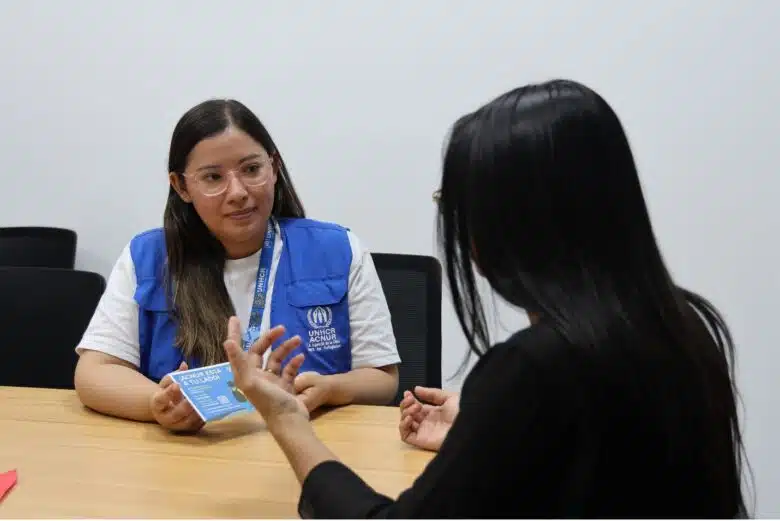
Lucía talks to a UNHCR staff about her story of resilience and desire to give back to the community. © UNHCR/Jacqueline Henriquez
A future lawyer committed to serving her community
Due to several challenges, Lucía had left her studies years earlier and had only completed sixth grade. When she arrived in El Salvador, she decided to return to school. Encouraged by her work supervisor, she studied on her own, relying on online videos, and with support from the Ministry of Education, she managed to complete her basic education and graduate from high school.
“There were moments when I thought about giving up, but I always reminded myself that moving forward was the only option. After everything I went through, I could not give up,” she says.
All the challenges she faced inspired a new dream in her: to study law
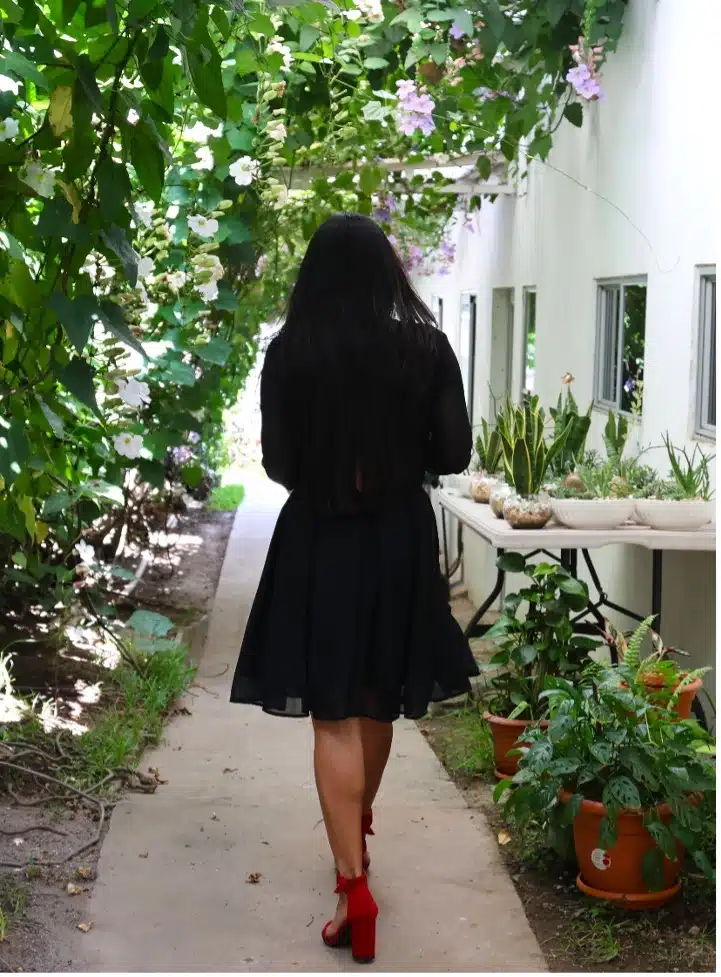
With hope and determination, Lucía continues moving forward, showing that a new beginning is always possible. © UNHCR/Jacqueline Henriquez
“My passion for legal sciences began when I asked for help after everything I experienced. That is when I understood that I wanted to help others. Today my goal is to accompany other people who go through similar situations, so that no one feels alone,” says Lucía, now in her second year of law school.
She is currently completing her internship at a national institution, where she collaborates in areas related to mediation and constitutional matters.
Lucía has clear plans: to graduate, pursue a master’s degree in international law, and, one day, open her own law firm. She also dreams of creating a space where women, youth, and refugees who have experienced violence can learn new skills, generate income and rebuild their lives in a safe environment.
“It doesn’t matter your nationality, skin color or religion. We are all equal and we all have the same rights. Refugees also bring skills and want to contribute to the country that receives us.”
For her, her journey is sustained by a deep conviction: “The hope for a better future, of being the protagonist of my own story, of shining. What matters is to keep moving forward. Hope keeps us alive.”
Lucia’s journey shows that when a refugee have access to opportunities — education, work and tools to build their life project — they not only transform their own future but also drive change, inspire others and contribute to the development of their community and the country that receives them.
The role of international cooperation
Durable solutions are key to advancing the implementation of the Global Compact on Refugees and form part of regional efforts promoted through the Comprehensive Regional Protection and Solutions Framework (MIRPS), which El Salvador leads as Pro-Tempore Presidency in 2026. As a Member of the MIRPS Support Platform, Canada supports countries in Central America and Mexico in these efforts.
These actions are also framed within the principles of the Cartagena Declaration and the Chile Action Plan 2024–2034, which reaffirms the commitment of States across the region to the protection and inclusion of forcibly displaced people.
The solidarity partnership between the Government of El Salvador and UNHCR has enabled progress in a comprehensive process to strengthen the asylum system, including improvements tofacilities and essential tools for processing asylum applications, as well as the development and dissemination of informative materials to promote the rights of forcibly displaced people.
UNHCR’s collaboration has also included training programmes for civil servants on international refugee law and operational strengthening of CODER. In 2025 and 2026, the UNHCR project, financed by the Government of Canada through the support of Immigration, Refugees and Citizenship Canada (IRCC), will contribute to strengthening the asylum system in El Salvador so that people with protection needs can access an efficient and fair process, and opportunities to rebuild their lives with dignity.
*Name changed for protection reasons.