


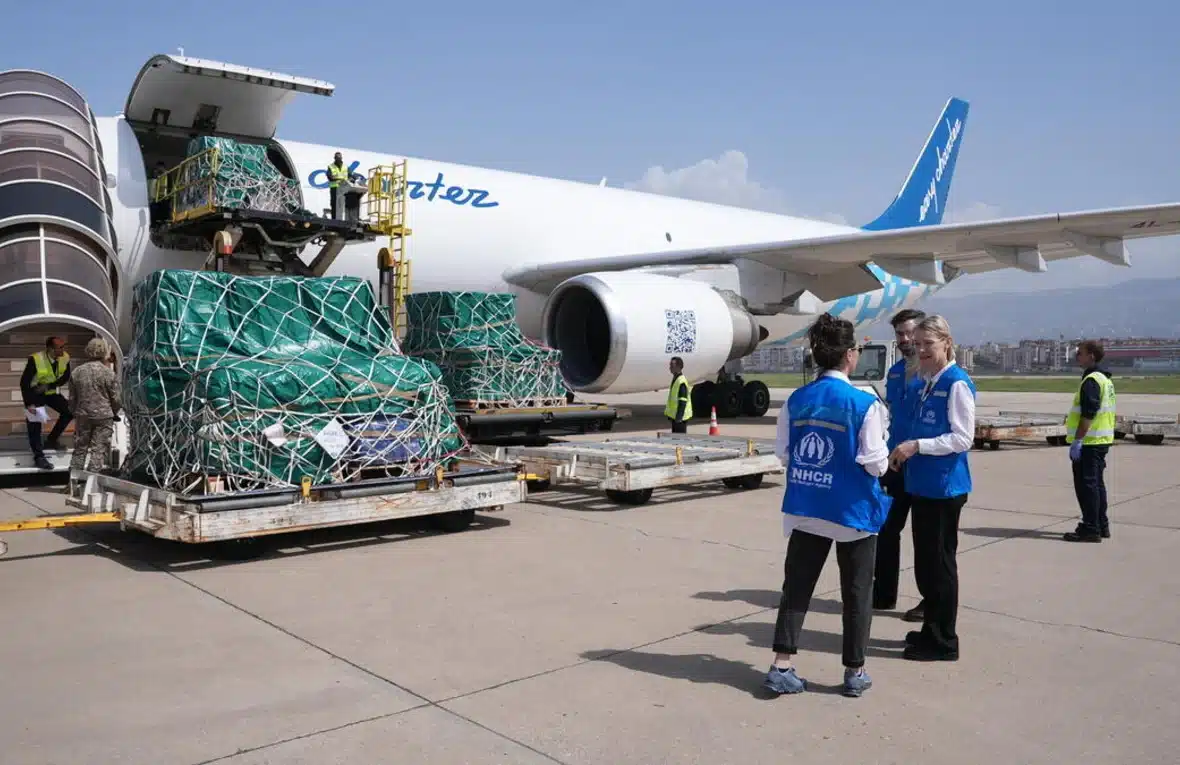
UNHCR team in Lebanon receive an airlift carrying more than 11,000 essential relief items. © UNHCR/Houssam Hariri
This is a summary of what was said by UNHCR spokesperson Carlotta Wolf – to whom quoted text may be attributed – at today’s press briefing at the Palais des Nations in Geneva.
GENEVA – The Middle East crisis has generated far‑reaching ripple effects well beyond the region, with growing consequences for global humanitarian supply chains and the delivery of aid, as spikes in transport costs and freight disruptions are forcing UNHCR, the UN Refugee Agency, to adapt its delivery strategy.
Heightened insecurity and instability around key Gulf routes, including the Strait of Hormuz, have disrupted maritime traffic. Rising fuel, food and freight costs worldwide are driving up prices and delaying the delivery of critical supplies.
Higher transport and fuel costs disproportionately affect people in emergencies, including millions of refugees and displaced people with reduced and delayed life-saving support, while also reducing the ability of aid agencies to deliver timely assistance amid severe funding constraints. To mitigate disruptions, UNHCR has adapted quickly by rerouting sea cargo, for example around Aqaba, and by increasing reliance on alternative land corridors, including trucking across the Arabian Peninsula and Türkiye from Dubai.
The closure of key maritime routes has forced greater use of longer and more expensive alternatives, leading to increased transit times and operational complexity. Freight rates from key sourcing countries have risen by nearly 18 per cent since the start of hostilities, while the capacity of our global transport providers has dropped from 97 to 77 per cent since the start of 2026.
For some shipments, costs have more than doubled, such as transport costs for relief items from UNHCR’s global stockpiles in Dubai to our Sudan and Chad operations, which have increased from around $927,000 to $1.87 million.
Congestion at major ports, including Jeddah and Mersin, as well as carrier suspensions, rising fuel prices, and higher war‑risk insurance premiums, currently estimated at 0.5 to 1.5 per cent of cargo value for Gulf transits, are adding further pressure. Increased reliance on land routes is also leading to truck shortages and higher inland transport costs.
Particularly worrisome is the situation for Africa, where many overlapping displacement crises are ongoing – often tragically neglected. In Kenya, where one of UNHCR’s global stockpiles is located, a recent fuel price increase of around 15 per cent triggered delays and reduced truck availability for shipments to Ethiopia, the Democratic Republic of the Congo, and South Sudan. In Sudan, where the conflict has entered its fourth year, the cost of delivering aid has doubled in recent months, while rerouting shipments around the Cape of Good Hope adds up to 25 days in delivery times.
Amid the challenges, UNHCR has so far maintained the continuity of life‑saving assistance thanks to its strong preparedness systems and global supply network. This includes seven global stockpiles in Dubai, Termez, Copenhagen, Accra, Douala, Nairobi and Panama City, capable of supporting up to 1 million displaced people at any given moment, along with more than 160 country‑level warehouses and standby arrangements for local procurement and financial assistance. Globally, UNHCR retains stocks of over 31,000 metric tons and 135,000 cubic metres of relief items valued at approximately $130 million, which are a lifeline for people uprooted by conflict and persecution.
Since the onset of the crisis, UNHCR along with shelter sector partners has delivered relief items to over 200,000 displaced people in Lebanon, mostly using pre‑positioned supplies. Additional support has included three airlifts donated by the European Union, France, Ireland and Italy, and 40 trucks carrying over 317 metric tons of critical aid from Dubai, supporting up to 100,000 people.
If instability in the Middle East persists, rising costs, delays and limited transport capacity are likely to constrain humanitarian operations further. While UNHCR continues to adapt through rerouting, stock redeployment and donor‑supported logistics, prolonged disruption risks reducing the scale and speed at which assistance can reach people in need, with serious consequences for millions of refugees and displaced people worldwide.
For more information, please contact:
- In Geneva, Carlotta Wolf: wolf@unhcr.org, +41 79 546 67 07
- In Bangkok, Mariko Hall: hallma@unhcr.org, +66 63 003 2028
- In Amman, Rula Amin: aminr@unhcr.org, +962 (0) 790 045 84


