

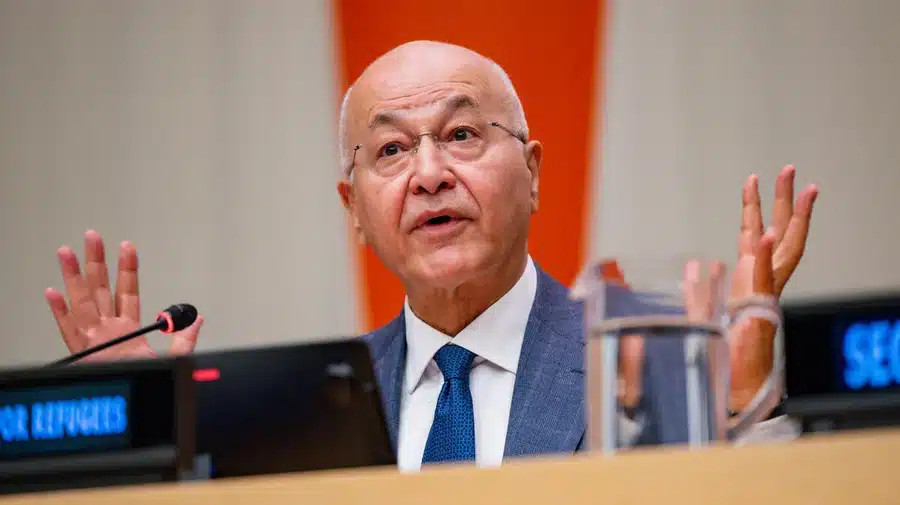
UN High Commissioner for Refugees Barham Salih welcomes States and partner organizations to a high-level event commemorating the 75th anniversary of the 1951 Refugee Convention at UN headquarters in New York. © UNHCR/Vincent Alban
As Delivered
By Barham Salih, UN High Commissioner for Refugees, in New York
Thank you so very much.
Excellencies, distinguished delegates, colleagues, refugees, partners, and friends, welcome, and thank you for joining us at this event as we mark the 75th anniversary of the 1951 Refugee Convention.
Seventy-five years ago, in the aftermath of the Second World War, nations came together around a simple but profound principle: that people who are forced to leave their homes should not be left without protection.
That principle became the Refugee Convention. For three quarters of a century, it has provided safety, rights, and hope for millions.
It has delivered for humanity.
Today, however, displacement is rising. Conflicts are multiplying, lasting longer, and placing immense strain on humanitarian systems and resources.
In this environment, the Convention is not less relevant. It is as relevant as ever, if not more.
But this anniversary cannot simply be about celebrating the past.
It must be about renewing our commitment for the future.
Across the world, from Sudan to Ukraine, from Myanmar to the Sahel, people continue to flee violence and instability. Humanitarian organisations can save lives and protect those forced to flee, but we cannot end the conflicts that drive displacement.
That requires political leadership.
Refugees are not the cause of displacement. They are its consequence.
I know something about that from my own personal life. I was once forced to flee my own country. I know what it means to lose your home, your community, and your future.
But I also know full well what it means when another country opens its doors and offers you the opportunity to rebuild your life.
That experience taught me a lasting lesson: protection is essential, but protection alone is not enough.
Most refugees do not want to remain refugees. They want peace, opportunity, and a future for their children. Above all, most want to return home safely, voluntarily, and with dignity when conditions allow.
That is why, Excellencies and colleagues, peace remains the most important solution to displacement.
Every conflict prevented, every ceasefire sustained, and every peace agreement honoured is ultimately a humanitarian achievement.
While conflicts persist, we must also help refugees build meaningful lives where they are. That means education, jobs, and opportunity. It means supporting host nations and communities. And it means bringing together humanitarian actors, development institutions, international financial institutions, and the private sector to expand self-reliance and solutions.
That is why UNHCR is placing renewed emphasis on solutions through our 50 by 35 initiative, working with governments, partners, and refugees themselves to help resolve some of the world’s most protracted refugee situations by 2035.
Because success should not be measured only by the number of people we assist. It should be measured by the number of people who no longer need our assistance because they have found a solution.
At the same time, I want to emphasise the need to preserve the integrity of the asylum system— protecting the asylum system— including from abuse. The right to seek asylum remains a cornerstone of international protection. It must remain accessible to those who genuinely need it and credible in the eyes of the public.
The Convention has endured for 75 years because it speaks to both law and humanity. Its message is simple: when people are forced to flee, they should not be left alone.
But preserving that promise requires more than just words. It requires us to protect those forced to flee, support those who host them, invest in inclusion, self-reliance, and solutions, and to summon the political courage needed to prevent and resolve the conflicts that drive displacement.
Seventy-five years after the Convention was adopted, the question is not whether its principles still matter.
The question is whether we still have the determination to uphold them.
I believe we do.
And if we match the vision of those who created this Convention 75 years ago, future generations may look back on our time not as an era that merely managed displacement, but as one that worked to resolve it.
Thank you.