


On February 10, 2026, UNHCR Canada was invited to appear before the Senate Social Affairs, Science and Technology Standing Committee as part of its study of Bill C-12, an Act respecting certain measures relating to the security of Canada’s borders and the integrity of the Canadian immigration system and respecting other related security measures .
Azadeh Tamjeedi, UNHCR Canada senior legal officer, presented on behalf of UNHCR. Video of the meeting can be found at this link.
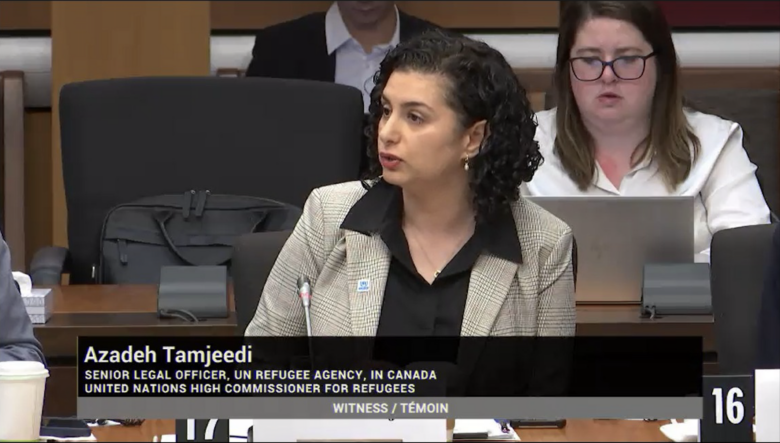
Azadeh Tamjeedi, UNHCR Canada senior legal officer, presents on behalf of UNHCR.
Thank you for the opportunity to appear before you today regarding Bill C-12. As the UN agency serving refugees and asylum-seekers in 134 countries and territories, providing technical advice on building a strong asylum system is an integral part of our advisory role.
Canada is not unique when it comes to seeing an increase in asylum claims. By the end of June 2025, 117.3 million people worldwide were forced to flee from their homes due to persecution, conflict, violence, and human rights violations.
Given this context, UNHCR recognizes that governments, like Canada, must strike a balance between managing migration flows, ensuring border security, and maintaining public confidence in asylum systems. In doing so, they must abide by their international obligation to grant refuge to those at risk of persecution.
Regarding Bill C-12, UNHCR notes that the proposed legislation is dependent on amendments to the Immigration and Refugee Protection Regulations and we cannot provide a fulsome analysis of the legislation without seeing the drafted Regulations. We welcome elements that reflect past UNHCR recommendations. We look forward to further consultations on how the Bill will be implemented and on draft regulations.
Today, UNHCR would like to focus our recommendations on the new ineligibility provisions. In Bill C-12, individuals found ineligible under two new provisions would receive a Pre-Removal Risk Assessment, a PRRA. Like the Immigration and Refugee Board (IRB), the PRRA could grant refugee or protected person status. It was originally designed to be used prior to removal after someone has exhausted all their options in Canada, including a hearing at the IRB. However, if the PRRA is used to conduct the first assessment of an individual’s asylum application, as this legislation proposes, it should incorporate safeguards to comply with international and domestic law.
First, UNHCR recommends that a mandatory hearing be added to ensure an individual’s right to be heard, unless there is overwhelming evidence to accept their case based on the written evidence provided. Having sat through many first-instance refugee hearings, I can tell you that a claimant’s opportunity to tell their story provides details and context when decision-makers doubt aspects of the case. Through direct questioning, decision-makers can test the plausibility of claims, clarify inconsistencies, and better assess credibility in real time in cases where evidence is lacking. Hearings allow for closer scrutiny of evidence, reducing the risk of accepting non-genuine claims and accepting those that meet the refugee definition.
Second, we would recommend that those deemed ineligible under these new provisions have the right to a full appeal at the Refugee Appeal Division of the IRB, which would also stay their removal until the appeal is heard. This would minimize the risk of returning a person to a place where their life would be in danger if there was an error in the PRRA decision. Important decisions such as these are subject to human error and there should be a safety net that utilizes the strong tools Canada already has at its disposal. This would also increase overall system efficiency by reducing the reliance on the overburdened Federal Court for judicial reviews.
The final amendment we would recommend is that those from countries that benefit from a suspension on removals be granted exceptions to these new ineligibilities so that they could have their asylum claims assessed in a timely manner. Currently, if an individual from a country, like Sudan or Afghanistan, is deemed ineligible under one of these new provisions they will not have their cases heard. Individuals from these countries typically have strong cases for asylum given country conditions and should not have to live in limbo.
We hope that Canada continues to be a champion for fast, fair and efficient asylum systems and to lead in an environment when other countries are closing the door on the principle of asylum.
We have seen firsthand how the Refugee Convention has saved millions of lives in the last 75 years. Its relevance is proved every day when we meet the woman subject to gender-based violence in Haiti, the human rights activist from Afghanistan, or the child escaping violence in Sudan. Their stories illustrate why this legislation should be carefully considered and serve as a reminder that these proposed changes have a very real impact on human lives.
For this important reason, UNHCR remains committed to working with the Canadian government and civil society to ensure that the new measures are implemented in a manner that is consistent with best practices, provides protection to those who need it and builds a stronger system that is able to respond to the challenges of the future.
Thank you.