

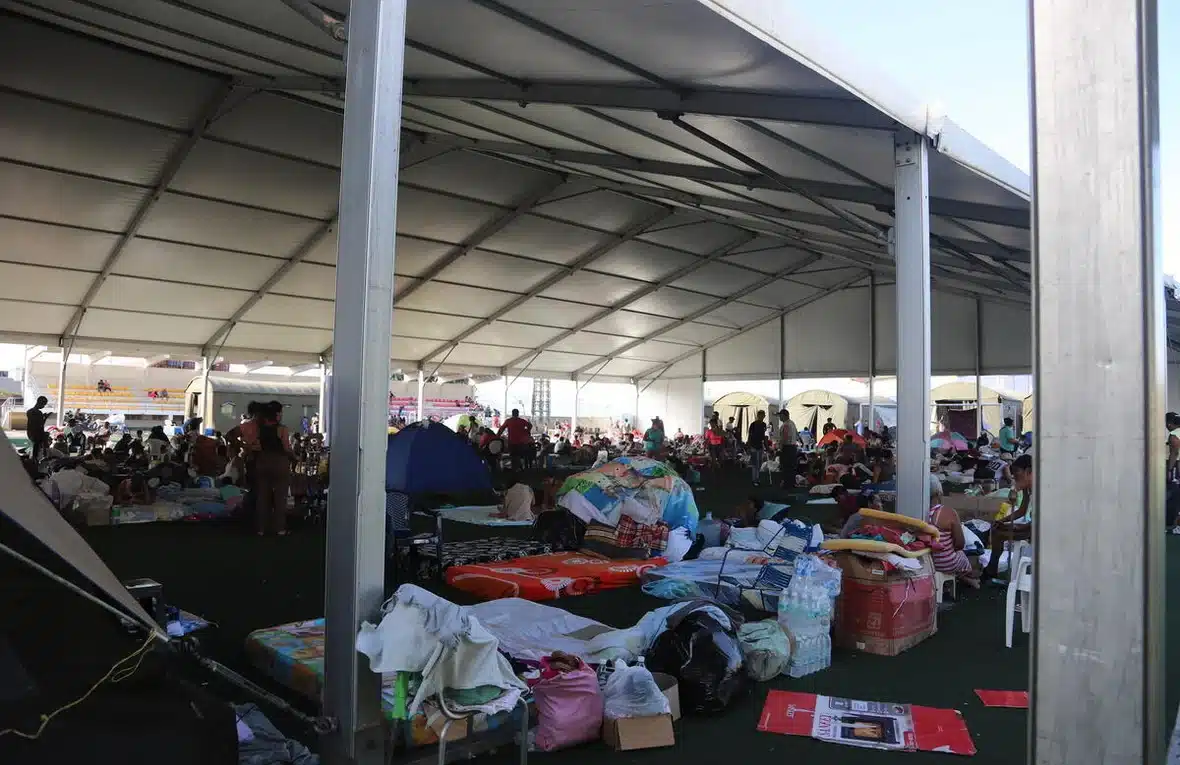
A temporary shelter for people affected by the deadly earthquakes at the José María Vargas Sports Complex in La Guaira, Venezuela. © UNHCR/Andrea Sarabia
This is a summary of what was said by UNHCR spokesperson Carlotta Wolf – to whom quoted text may be attributed – at today’s press briefing at the Palais des Nations in Geneva.
GENEVA – Initial, on-the-ground needs assessments from Venezuela have revealed a dramatic surge in humanitarian and protection needs in recent days as teams evaluate the full impact of last week’s devastating earthquakes. In La Guaira – the hardest-hit state – food shortages are widespread, basic services have broken down, and connectivity has been largely severed. Community tensions are rising as access to assistance remains constrained.
UNHCR, the UN Refugee Agency, has immediately mobilized to support affected communities, and conducted a rapid needs assessment on 26-27 June with participants across La Guaira, the Capital District, Miranda, Aragua, and Carabobo states. The initial findings showed that:
- 75 per cent of respondents had reported injuries in their communities; 56 per cent reported fatalities.
- Older people and those with disabilities face compounded risks, due to limited mobility and reduced access to digital information.
- Half of those assessed are staying with neighbours or relatives, 39 per cent are living in streets and public spaces, and others in churches, schools, or improvised facilities.
- Improvised shelters do not meet minimum protection standards, for example for privacy, safe spaces and basic levels of hygiene and comfort.
- 17 per cent of those surveyed reported the presence of unaccompanied or separated children in their communities.
The UNHCR-led Protection Cluster has launched a campaign to address child protection risks, particularly family separation. Efforts focus on awareness-raising, identification, family tracing, and ensuring children’s safety.
UNHCR is scaling up life-saving assistance and protection services across multiple fronts. We are supporting local authorities with tools and equipment for the safe collection and management of information on affected people, helping identify specific needs and facilitate referrals to appropriate services.
At the same time, emergency supplies are being transported from UNHCR’s local warehouse in Táchira to La Guaira, with additional capacity to mobilize more than 20 tonnes of relief items from UNHCR’s global stockpiles in Panama to further bolster assistance. UNHCR partner CARITAS has established a donation collection and storage centre at the Episcopal Conference premises, including with UNHCR tents and a rub hall, to support aid distributions.
Authorities have confirmed 1,719 fatalities, at least 5,034 people injured, and 15,866 people affected as of 29 June. Infrastructure damage is extensive: a total of 189 structures have collapsed, while 666 have sustained damage or partial collapse.
As the situation evolves and protection risks grow, UNHCR reiterates the importance of timely, flexible support for people in dire need, across all the affected communities. UNHCR requires an estimated $14.85 million to scale up protection, core relief items, and temporary shelter support for 30,000 earthquake-affected people over six months.
For more information, please contact:
- In Geneva, Carlotta Wolf, wolf@unhcr.org, +41 79 546 67 07
- In Panama City, Stefano Zanfardino, zanfardi@unhcr.org, +507 6979-6818