


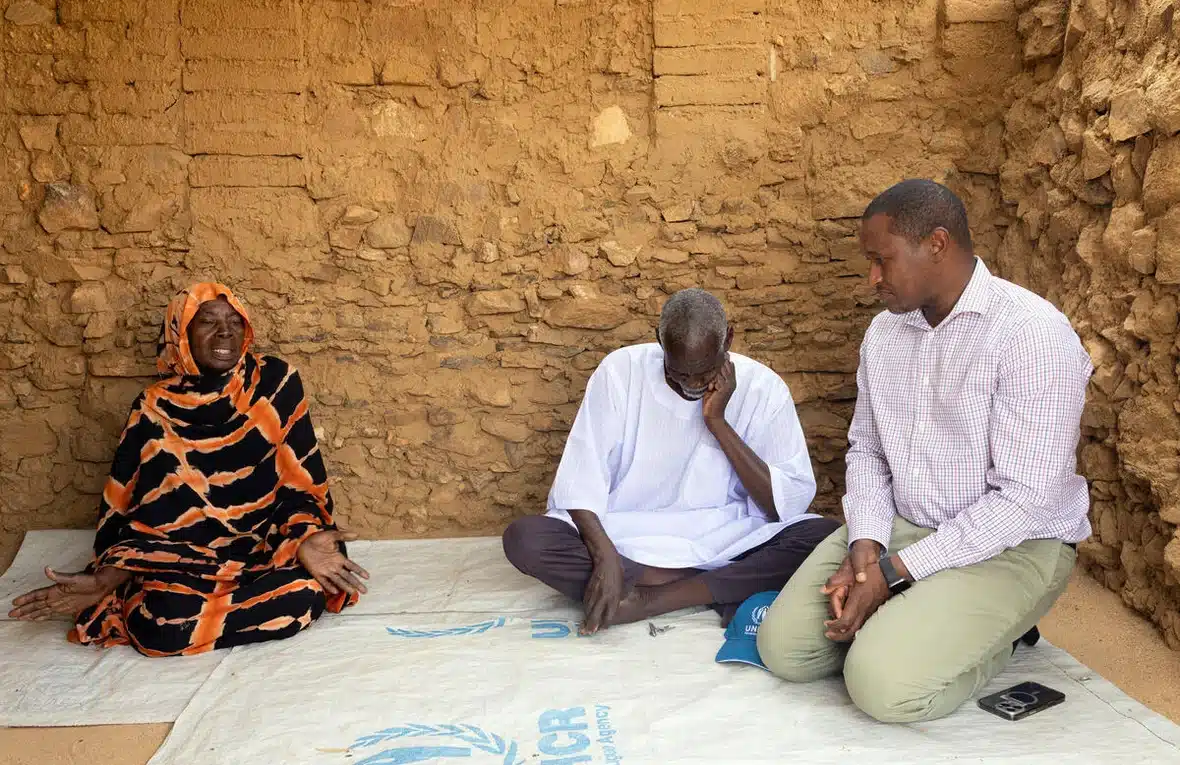
UNHCR Regional Refugee Coordinator for the Sudan situation, Mamadou Dian Balde (right), listens to the harrowing story of Sudanese refugees Leila and Ousmane at the Kouchaguine Moura site, eastern Chad. © UNHCR/Hélène Caux
This is a summary of what was said by Mamadou Dian Balde, UN Regional Refugee Coordinator for the Sudan Situation and UNHCR Regional Director for Eastern and Southern Africa – to whom quoted text may be attributed – at today’s press briefing at the Palais des Nations in Geneva.
GENEVA – More than 55,000 Sudanese refugees have fled to eastern Chad so far this year, as continued fighting and worsening insecurity in Darfur, the Kordofans and other parts of Sudan force more families to seek safety across the border. Since the conflict began in April 2023, almost 1 million refugees have crossed into Chad.
Over the past week, the pace of arrivals has accelerated sharply, with more than 400 people a day crossing the border areas of Adré and Tiné in eastern Chad – around 20 times the daily rate seen over the previous few months.
The situation is particularly dire in the Darfur states, while UNHCR is also increasingly concerned about developments in Kordofan and Blue Nile States, where fighting and insecurity, including airstrikes and drone attacks, are forcing more people to flee and making humanitarian access even more difficult. Climate shocks are adding to displacement pressures. Localized drought, below-average rainfall and water scarcity are already affecting livelihoods, while the coming rainy season could bring flooding in parts of Darfur, damaging infrastructure, disrupting services and triggering further displacement.
In Tiné, in eastern Chad, the transit centre is already hosting more than 4,300 people and is under significant pressure, with urgent needs for shelter, water, sanitation and protection services. Newly arrived refugees continue to describe the devastating human cost of the conflict. Women and girls have reported grave violations, including kidnapping and rape, during their journeys to safety in Chad from Sudan.
Sudan remains the world’s largest displacement crisis, with some 11.3 million people forcibly displaced since the conflict began, including 6.4 million inside the country. More than 3.5 million Sudanese refugees and asylum-seekers have fled across the region, heaping pressure on already overstretched neighbouring countries.
Despite the generosity of Chad and other host countries, humanitarian support is not keeping pace with needs. In Chad, over 190,000 refugees remain in difficult conditions in border areas, awaiting relocation to planned settlements further inland. Some 31,000 families are without adequate shelter, and most refugees are surviving on less than half the minimum amount of water needed daily.
At the same time, Chad has taken important steps to include refugees in national systems and expand opportunities for self-reliance, including for the growing number of highly skilled and qualified Sudanese refugees. More than 400 health workers have had their qualifications recognized, with some already supporting health services in eastern Chad. Refugee teachers are also authorized to teach, with at least 2,900 working in schools in the east.
The consequences of declining support extend beyond the immediate region. UNHCR’s latest analysis of Sudanese movements towards Europe shows that onward journeys are often not a single decision made when leaving Sudan, but the result of repeated attempts to find safety, legal status and a viable future in countries of asylum.
Whilst overall refugee arrivals of all nationalities to Europe via the Mediterranean have decreased, Sudanese arrivals by sea to Europe have risen significantly since the conflict began, with 14,104 recorded in 2025, a 245 per cent increase from 4,094 in 2024. UNHCR’s analysis found that unmet protection and basic needs in first countries of asylum are among the factors contributing to onward movement.
UNHCR is calling for renewed international support for people affected by the conflict inside Sudan and for neighbouring countries, including Chad, that continue to keep their borders open and host millions of refugees. Currently only 18 per cent of the $1.6 billion required for the regional refugee response plan has been received.
Without greater humanitarian and development support, the situation for the millions displaced will deteriorate further, increasing pressure on refugees to make impossible decisions, such as returning to Sudan before conditions are safe or undertaking dangerous onward journeys in search of safety and stability.
Related links:
For more information, please contact:
- In Chad, Hélène Caux, caux@unhcr.org, + 235 85 15 81 34
- In Nairobi (regional), Faith Kasina, kasina@unhcr.org, +254 113 427 094
- In Dakar (regional), Fidelia Bohissou, bohissou@unhcr.org, +221 77 569 91 60
- In Geneva, Eujin Byun, byun@unhcr.org, +41 79 747 8719


