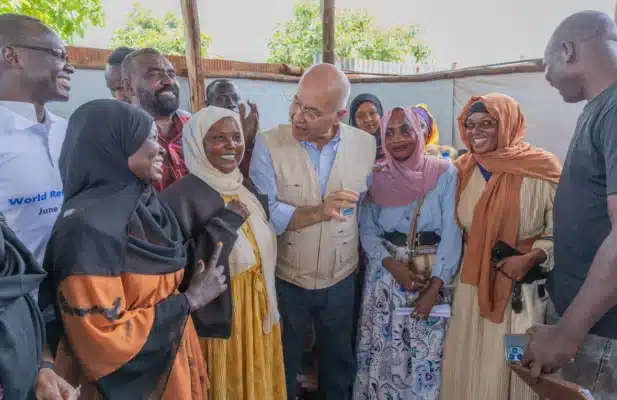


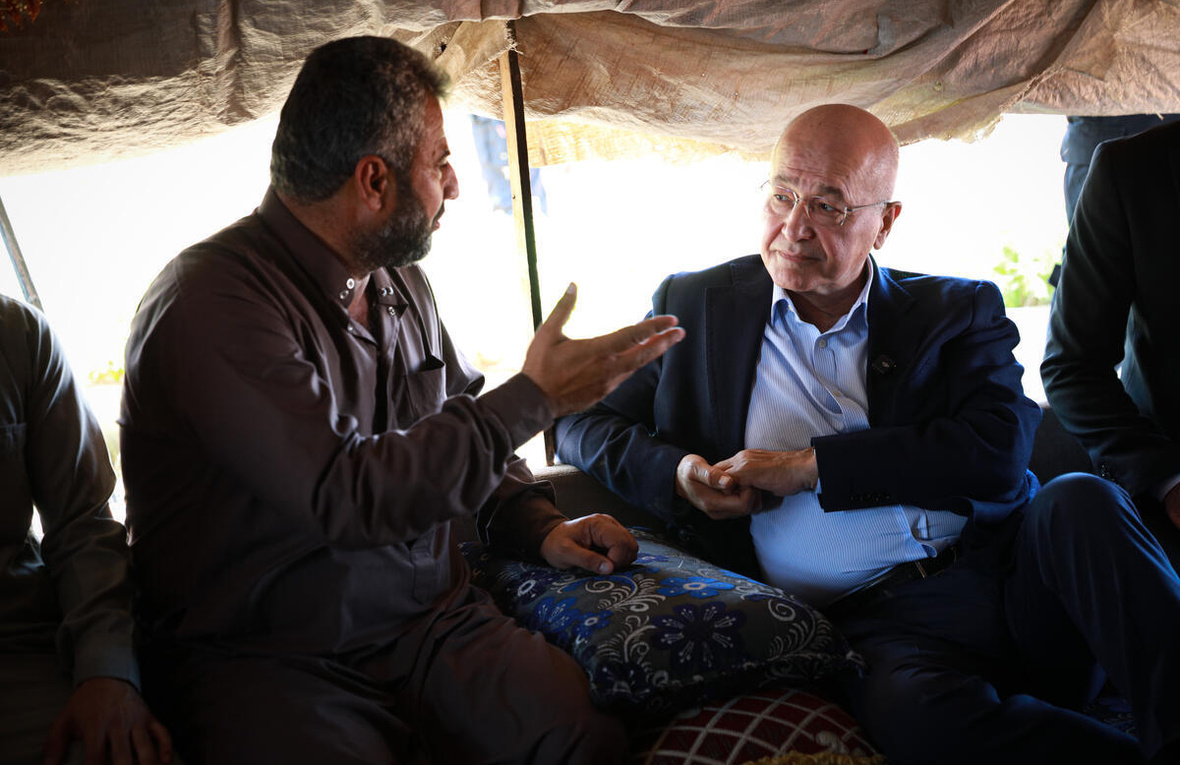
At Al-Hijra Camp in Idlib, northern Syria, UN High Commissioner for Refugees Barham Salih met displaced families and heard about their hopes for the future. © UNHCR/Hameed Maarouf
DAMASCUS – United Nations High Commissioner for Refugees Barham Salih today called on the international community to rapidly scale up support to Syrians, saying the country stands at a critical juncture as growing numbers of refugees and internally displaced people return after years of conflict.
Concluding a week-long visit to Syria, Salih urged government, development and financing partners to translate the momentum around returns into tangible support for recovery, livelihoods, infrastructure and basic services, while continuing to address significant humanitarian needs.
“Syria is at a historic turning point,” he said. “More than three million Syrians have already returned from abroad or inside the country since December 2024, demonstrating their determination to rebuild. Recovery on this scale is a huge task, and Syria cannot do it alone. The international community must step in, and swiftly. Without this, a historic opportunity to help the country rebuild and to stabilise the region will be missed.”
The visit underscored UNHCR’s commitment to Syria as the country moves from years of displacement towards recovery, reintegration and stabilization. Traveling to Damascus, Idlib and Aleppo governorates, the High Commissioner met government leaders, displaced families, returnees and local communities to see first-hand the progress being made and the substantial challenges that remain.
In Damascus, he met President Ahmad Al-Sharaa, the Foreign Minister and members of the Government’s inter-ministerial committee responsible for advancing Syria’s “No Tents, No Camps” vision.
“A peaceful and inclusive Syria is the foundation for sustainable recovery,” Salih said. “Syrians are determined to rebuild. The international community must match that determination with sustained support.”
UNHCR is working closely with Syrian authorities, UN agencies and development partners to address immediate humanitarian needs and create conditions for sustainable return. Support includes shelter rehabilitation, restoration of basic services, legal and civil documentation, housing, land and property assistance, livelihoods programmes and cash assistance. UNHCR is engaging with the World Bank to support Syria’s national priorities.
In Damascus, Salih met families who had recently returned from neighbouring countries and told him how access to civil documentation — including birth certificates — is enabling children to enrol in school, receive vaccinations and exercise their basic rights. At Al-Hijra camp in Idlib, displaced families explained how destroyed homes and lack of basic services in their original towns and villages meant they were still unable to go home. In Maaret Al-Numan, in Idlib Governorate, he visited a cadastral office that UNHCR helped renovate, which enables people access their land and property deeds and exercise their rights.
As nearly 4 million Syrian refugees remain in Türkiye, Lebanon, Jordan, Iraq and Egypt, UNHCR reaffirmed its commitment to supporting host governments to protect refugees and ensure that any returns are voluntary, in safety and dignity, while still investing inside Syria to help those refugees choosing to return home. At the same time, approximately 5.5 million people are still displaced inside Syria. Any returns must be safe, voluntary, and dignified, Salih stressed.
Media contacts:
- In Damascus: Annalaura Maria Sacco, sacco@unhcr.org, +963 989 892 904
- In Amman: Rula Amin, aminr@unhcr.org, +962 (0) 790 045 84
- In Geneva: Babar Baloch, baloch@unhcr.org, +41 79 513 9549