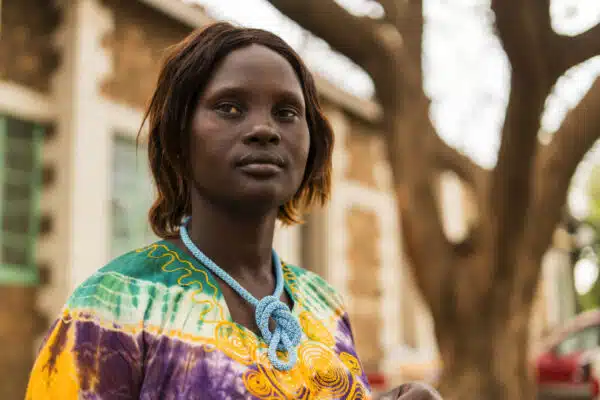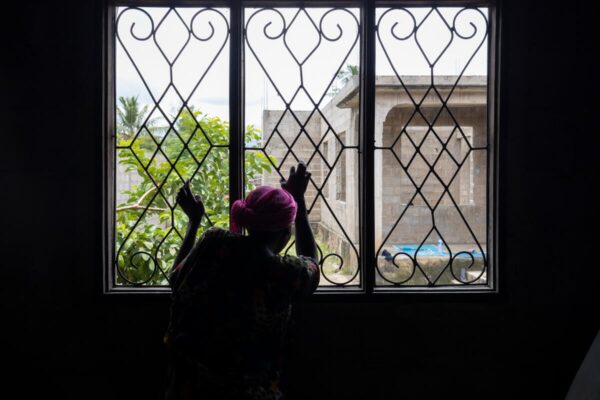


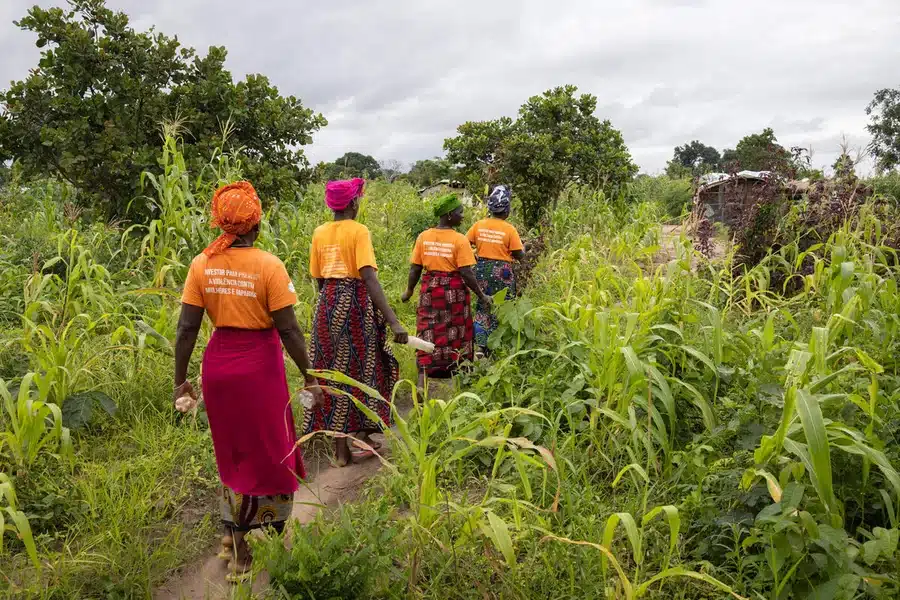
Survivors of sexual violence return to their shelters after a support group session in Lianda IDP camp in Mozambique’s Cabo Delgado province, February 2024. © UNHCR/Hélène Caux
This is a summary of what was said by Edem Wosornu, UNHCR Assistant High Commissioner for Protection, to whom quoted text may be attributed, at today’s press briefing at the Palais des Nations in Geneva.
GENEVA – As the 16 Days of Activism against Gender-Based Violence get under way, UNHCR, the UN Refugee Agency, is warning that funding cuts are severely weakening protection for refugee and stateless women and girls and others at risk of gender-based violence (GBV).
Across 14 country operations*, UNHCR’s 2025 GBV Impact Report found that 171 safe spaces supported by UNHCR and partners were shuttered last year, with further closures in 2026; 203 remained open. These spaces are critical for women and girls to safely access psychosocial support, medical and legal aid, and prevention activities. When safe spaces close, specialized services are cut, or referral pathways weakened, survivors have fewer opportunities to safely disclose abuse and seek help.
The closures are part of a recent erosion of GBV services. In 2025, UNHCR’s GBV programmes were less than one-third funded. As a result, 5.6 million forcibly displaced and stateless people globally were left without life-saving prevention and response services.
Despite severe underfunding, UNHCR’s specialized GBV programmes reached 2.2 million people in 77 countries worldwide in 2025 and the first half of 2026. This reflects the agency’s unique protection mandate, critical role and expertise in preventing GBV, identifying the specific risks faced by refugees, displaced and stateless people, and supporting survivors with access to registration, documentation, asylum, and the specialized care needed for recovery.
In all, 63 per cent of UNHCR operations reported delays in survivors accessing specialized GBV case management services due to staffing reductions among partners. A further 74 per cent reported rising caseloads per caseworker, stretching frontline services and affecting the timeliness and quality of support. These cuts leave survivors with fewer safe places and increase the risk of re-traumatization, continued violence and serious physical and mental health consequences.
I recently returned from Nigeria, my first field visit as UNHCR’s Assistant High Commissioner for Protection, where I met young women who had survived years of captivity and unimaginable violence at the hands of Boko Haram. For some, captivity began as a little girl as young as nine.
Mariam, one of the young women I spoke with, was held captive for ten years, repeatedly abused by multiple men, and had children in captivity. “They come and pick girls,” she told me. After escaping, she “felt like she was taken out of a fire”.
For many of these young women, what follows can also be difficult as they face rejection and stigma in their own families and communities. Today, Mariam and other survivors are receiving support and vocational training through a government-run initiative supported by UNHCR and partners, helping them recover in dignity after so much was taken from them.
Gender-based violence is one of the world’s most pervasive human rights violations, hence the need for the 16 Days. Nearly one in three women globally has experienced physical or sexual violence. More than 60 million forcibly displaced and stateless women and girls face heightened risks of violence, yet funding cuts are slashing specialized services when they are needed most.
We must not mistake silence for safety. And we cannot allow shrinking humanitarian funding to make violence against women and girls both more prevalent or less visible.
A new UNHCR-led analysis from Bangladesh, Jordan, Lebanon, South Sudan and Tanzania, compiled in the GBV Trends Report, shows that less reporting does not mean lower risks, especially where GBV services are shrinking due to underfunding. This was particularly evident in Lebanon, where new conflict-related displacement and temporary service suspensions coincided with a sharp decline in recorded incidents, and in Jordan and Tanzania, where funding cuts further restricted UNHCR’s ability to support.
Across the five countries, 42 per cent of recorded incidents were disclosed within five days, with 29 per cent only after more than a month, delaying access to critical support. Earlier disclosure was associated with accessible, trusted services, functioning referral pathways and community-based mechanisms.
Women and girls accounted for 98 per cent of recorded survivors, while nearly 88 per cent of incidents occurred in private residential settings. Overcrowding, a lack of safe work and limited freedom of movement can exacerbate risks. Access to justice remains another serious challenge, with only 9 per cent of survivors referred to legal services, due to documentation and language barriers, discrimination, lack of trust or fear of retaliation.
The women and girls I met in Nigeria and elsewhere on my missions to Senegal and Egypt showed extraordinary strength. But their safety should not depend on their resilience alone. More support is urgently needed. And women-led, refugee-led and community-based organizations, who play a critical role, need sustained investment.
During these 16 Days, our call to governments and donors is clear: protect life-saving services, invest in prevention, ensure justice and GBV services include refugees and stateless people, and support local organizations to ensure that no woman or girl forced to flee is left without somewhere safe to turn.
Read the reports
*These include the Syrian Arab Republic, Pakistan, Sudan, the Democratic Republic of the Congo, South Sudan, Niger, Colombia, the Republic of Moldova, Honduras, Yemen (Aden), the United Republic of Tanzania, Ethiopia, Uganda and Ecuador.
For additional information, please contact:
- In Geneva, Matthew Saltmarsh, saltmars@unhcr.org, +41 79 967 99 36
- In Geneva, Carlotta Wolf, wolf@unhcr.org, +41 79 546 6707