


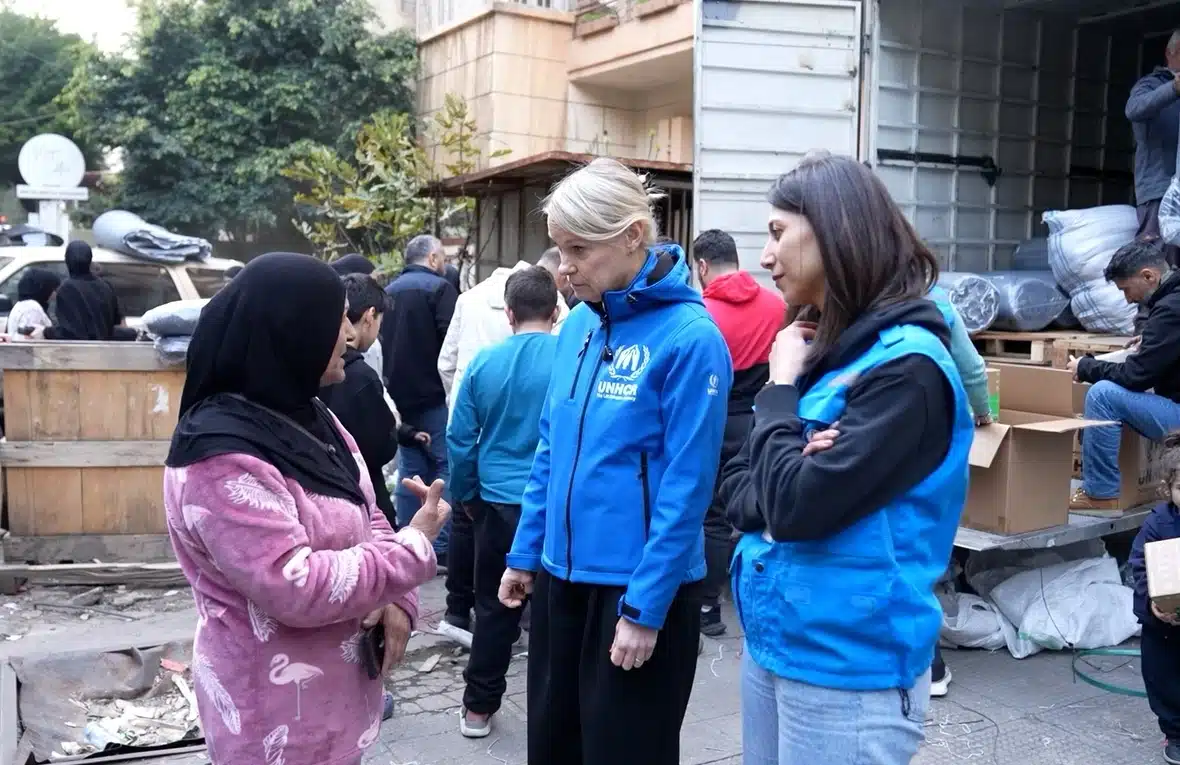
Haniya (left), one of tens of thousands displaced across Lebanon by Israeli airstrikes and warnings to evacuate, attends a UNHCR distribution in Beirut. © UNHCR
The following news comment can be attributed to Matthew Saltmarsh, UNHCR global spokesperson.
GENEVA – Intensifying hostilities across the Middle East have triggered significant population movement, while clashes along the border between Afghanistan and Pakistan have forced thousands of families to flee. Overall, more than 330,000 people have been forcibly displaced, mostly within their own countries.
UNHCR, the UN Refugee Agency, is already supporting displaced populations and preparing to scale up its assistance as needed. We are also urgently calling for dialogue and de-escalation as violence intensifies.
In Iran – a long-term host to 1.65 million people forced to flee, mostly from Afghanistan – around 100,000 people left Tehran in the first two days following the attacks, according to local estimates. More recent figures are not yet available.
However, there has so far been no major increase in cross-border movements from Iran linked to recent events.
In Lebanon, over 84,000 people are now sheltering in nearly 400 collective sites, the government reports. And over 30,000 people – mostly Syrians but also some Lebanese – have crossed into Syria since the escalation began, according to authorities.
Meanwhile, the situation in Afghanistan and Pakistan remains tense amid active conflict along the border, with reports of internal displacement in both countries, including an estimated 115,000 people in Afghanistan and around 3,000 people in Pakistan.
It is imperative that all civilians who need to move or cross borders to find safety are given safe passage.
View the b-roll here.
For more information, please contact:
- In Geneva, Babar Baloch: baloch@unhcr.org, +41 79 513 95 49
- In Amman, Rula Amin: aminr@unhcr.org, +962 (0) 790 045 84
- In Bangkok, Mariko Hall: hallma@unhcr.org, +66 63 003 2028
Originally published by UNHCR on 5 March 2026


