


On June 3, 2026, UNHCR Canada was invited to appear before the House of Commons’ Standing Committee on Citizenship and Immigration (CIMM) as part of its study of Attracting and Empowering Global Talent to Strengthen Canada’s Economy. Michael Cassasola, UNHCR Canada’s Senior Resettlement and Complementary Pathways Officer presented on behalf of UNHCR.
Video recording of the CIMM appearance (June 3, 2026)
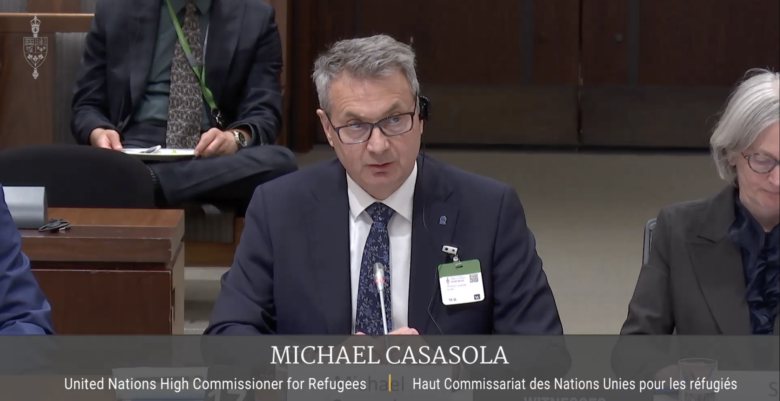
On June 3, 2026, UNHCR Canada was invited to appear before the House of Commons’ Standing Committee on Citizenship and Immigration (CIMM) as part of its study of Attracting and Empowering Global Talent to Strengthen Canada’s Economy. Michael Cassasola, UNHCR Canada’s Senior Resettlement and Complementary Pathways Officer presented on behalf of UNHCR.
UNHCR is pleased to appear as part of the Committee’s study on attracting global talent. Refugees represent an untapped talent pool that Canadian employers have only recently been able to reach, thanks to the Economic Mobility Pathways Pilot or EMPP introduced in 2018. Providing an additional option for refugees with the commensurate skills to access Canada, UNHCR welcomed the EMPP and looks forward to Canada delivering on its pledge at the Global Refugee Forum to make the EMPP a permanent program.
Back in 2018 Canada was a pioneer, testing the extent to which refugees could access economic immigration programs without changing human capital requirements. This testing found that refugees have the skills and experience, but may face barriers related to their displacement, such as the inability to provide a valid passport. The EMPP was designed so that refugees could overcome these barriers and access economic immigration on a level playing field. Thanks to IRCC, NGO partners and employers more than 1 ,300 refugees have immigrated to Canada through the EMPP to date. The key learning has been constant: when given a chance, refugees can compete with other economic immigrants to provide much needed talent that allows businesses to maintain operations or expand.
From the outset, Canada has been clear that refugee labour mobility does not replace resettlement or asylum but instead offers an additional opportunity for refugees that meets the Immigration and Refugee Protection Act’s economic objectives. UNHCR affirms this approach, particularly in the global context of record levels of forced displacement and shrinking solution opportunities for refugees. Creative partnerships with civil society and the private sector are needed, as set out in the Global Compact for Refugees.
The private sector is critical to EMPP, as most applications have been anchored with a job offer. We’d like to acknowledge employers such as Glenhaven Manor, St Joseph’s Care Group, Tri-County Mennonite Homes, Newfoundland and Labrador Health Services, Chancellor Parks, Ice River Springs, and IKO Industries, among many others. These employers have made refugee recruitment an integral part of their international talent strategies, sometimes travelling to refugee camps for recruitment missions. As a result, refugees are on the job in communities such as Pictou County and Thunder Bay as well as in Canada’s major cities.
Just like other economic programs, EMPP needs to work smoothly for employers. We’ve heard their concerns about processing times and predictability. The EMPP has been affected by limited space in the annual levels plan and an inventory of applications, leading to long processing times. While this situation is similar for other economic immigration streams, refugees have difficulty meeting the requirements for temporary work permits that would allow them to start working while their permanent resident application is processed. We look forward to learning how IRCC will address this issue, informed by the evaluation of the pilot that is underway.
Our own research shows that the EMPP has delivered results. Our surveys found that EMPP alumni have a high rate of staying with their employer and/or sector and many experience career progression. UNHCR has also organized focus groups with EMPP alumni. What stands out is their drive and eagerness to invest in themselves through ongoing training and upskilling. Alumni expressed gratitude for the opportunity and would recommend immigrating through EMPP to other refugees.
Our research also uncovered that those arriving through EMPP have struggled with credential recognition, just like other economic immigrants. With partners, UNHCR is interested in how these issues could be addressed at a system, rather than individual, level. The Nova Scotia Pharmacy Regulators provide a great example. Their Jordan Pharmacy Licensure Pathway fast-tracked the pathway to practice for immigrants trained in Jordan, following a thorough evaluation of pharmacy education programs, meetings with the government of Jordan and assessment and recruitment of candidates. The initial cohort recruited through this initiative and now working as pharmacists in Nova Scotia includes 11 refugees and 6 Jordanian nationals.
With the EMPP as a permanent program, ideally with faster processing times and significant spaces, refugee inclusion could be mainstreamed. A reliable immigration pathway could unlock potential. It would allow employers looking for cohorts of skilled refugees to move forward with recruiting or regulators looking for systemic partnerships to proceed confident that the immigration route will facilitate. For our part, UNHCR is confident that the next nurse, roofer, and French immersion teacher in refugee circumstances is just waiting for the opportunity to put their skills to use and in turn help meet Canada’s unmet employment needs.