


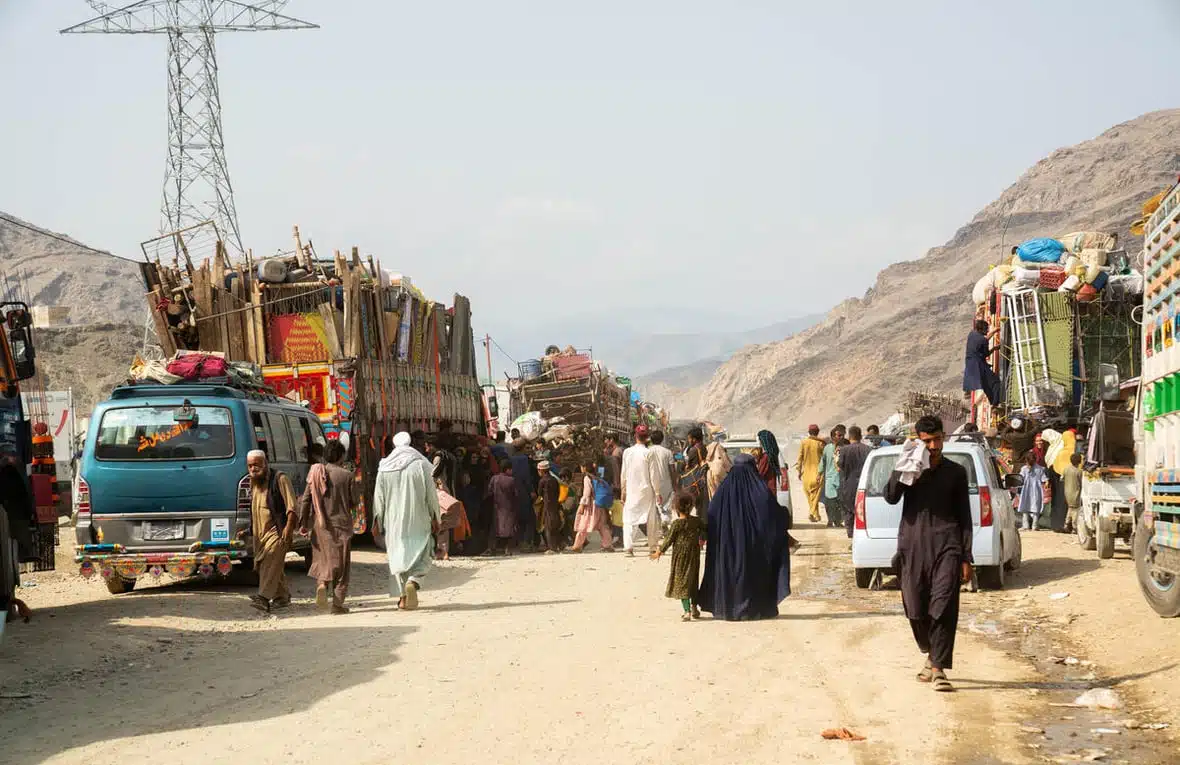
Afghan returnees cross the Torkham border point from Pakistan in September 2025, amid large-scale refugee returns from Pakistan and Iran since late 2023. © UNHCR/Oxygen Empire Media Production
This is a summary of what was said by UNHCR spokesperson Babar Baloch – to whom quoted text may be attributed – in response to questions received at today’s press briefing at the Palais des Nations in Geneva.
GENEVA – Staff at UNHCR, the UN Refugee Agency, are mobilizing from Iran and Afghanistan to Lebanon and Syria to support people forced to flee their homes as the regional crisis intensifies.
Many affected countries already host millions of refugees and internally displaced people. Given its footprint in the region, UNHCR is ready to play a leading role in the emergency responses.
UNHCR is closely monitoring the situation inside Iran, where it has had a presence since 1984 and is the largest UN agency, with offices in Tehran and five field locations. For now, we cannot confirm the number of people on the move within the country. But the situation is fluid, and the agency is ready to assist as requested by governments.
Iran hosts 1.65 million refugees and others needing international protection. UNHCR continues to assist and support them, despite logistical challenges. Refugee reception centres and helplines are open, providing counselling and other assistance. UNHCR continues to support services such as health, education and social protection. All our staff in the country are accounted for.
Even before this conflict, refugees in Iran were impacted by the country’s dire economic situation. High inflation and a rising cost of living have eroded fragile incomes, while limited access to employment left many struggling to meet their needs. Tighter residency controls and deportations increased insecurity, pushing some Afghans to return home under difficult conditions.
We are reviewing and reinforcing preparedness at Iran’s key border points. UNHCR urges all countries to keep their borders open to those fleeing the attacks; any rejection would amount to refoulement.
Media have reported movements at the Türkiye–Iran border in recent days. On Monday, crossings were within the usual range. The situation also remains stable along the Islam Qala border between Afghanistan and Iran, and movements at the Armenian border have been limited.
UNHCR is also highly concerned about the situation inside Afghanistan. The protection of civilians, including refugees and returnees, must remain a priority. Since October 2023, some 5.4 million Afghans have returned from Iran and Pakistan, many not by choice. So far in 2026, over 232,500 Afghans have returned (146,206 from Pakistan and 86,253 from Iran).
Mass and hasty returns significantly heighten protection needs, and risk further instability in Afghanistan and the region, including onward movement.
Meanwhile, recent hostilities between Afghanistan and Pakistan continue, displacing thousands in Kunar and Nangarhar provinces. Kunar was affected by last year’s earthquake and hosts a high number of returnees.
UNHCR and our humanitarian partners are ready to respond to any increase in returns, though resources are already significantly stretched following recent large-scale returns and funding shortfalls. UNHCR’s capacity to assist returnees has been significantly reduced due to funding cuts. UNHCR requires $454.2 million in 2026 to protect and assist forcibly displaced people in Afghanistan, Iran, Pakistan and Central Asia. As of end-February, only 15 per cent had been received.
Inside Afghanistan, both the Omari transit centre near the Torkham border crossing and the Takhtapul reception centre near the Spin Boldak border crossing have been impacted by strikes. The Torkham border crossing is currently closed, while Spin Boldak is open for Afghan returnees. UNHCR remains on the ground to respond to new displacement and any returnee movements.
UNHCR helplines in Pakistan and Afghanistan continue to operate, providing counselling and information to refugees and others in need of international protection.
Across the region, emergency supplies are available for rapid deployment from our regional and country-level stockpiles, including in Termez, Uzbekistan, which is strategically located near Iran. Supplies include family tents, blankets, sleeping mats, kitchen sets, buckets, jerry cans and solar lamps.
Should a more comprehensive response be required, emergency financial aid would be the primary form of assistance in many countries across the region. Systems and arrangements are already in place in Afghanistan, Iran, Iraq Türkiye, and Pakistan, among others, to enable a swift scale-up. UNHCR also maintains an emergency response roster if the need arises.
Meanwhile, heavy displacement is being reported across southern Lebanon, the Bekaa and the southern suburbs of Beirut after Israel issued evacuation warnings to residents of more than 53 villages amid intense airstrikes across the country.
As of Monday, around 30,000 people were being hosted and registered at government-designated collective shelters. Many more slept in their cars, on the side of roads or were stuck in traffic on roads leaving the south.
UNHCR is concerned by the escalation along the Lebanon-Israel border and calls for the protection of civilians as it closely monitors the situation and coordinates with the authorities and partners to respond. Our teams are providing core relief items to displaced families arriving at government-designated shelters across Lebanon.
There have also been increased crossings into Syria from Lebanon following the Israeli evacuation orders. According to Syrian authorities, around 11,000 people crossed from Lebanon on Monday, higher than the daily average. Our staff are present at the Syrian borders and UNHCR has plans in place for any possible influx from Lebanon, including pre-positioned supplies inside Syria.
In Iraq, UNHCR continues to closely monitor developments in contact with border authorities, although no changes have been observed so far. UNHCR stands ready to assist Iranian nationals and Afghan refugees and to support the government response as needed.
Watch the video of the briefing
Contribute to UNHCR’s Middle East Emergency appeal here.
For more information, please contact:
- In Geneva, Babar Baloch: baloch@unhcr.org, +41 79 513 95 49
- In Amman: Rula Amin, aminr@unhcr.org, +962 (0) 790 045 84
- In Bangkok, Mariko Hall: hallma@unhcr.org, +66 63 003 2028
Originally published by UNHCR on 3 March 2026


